
The Medusa Heads of the Basilica Cistern: Origins, Orientation & Meaning
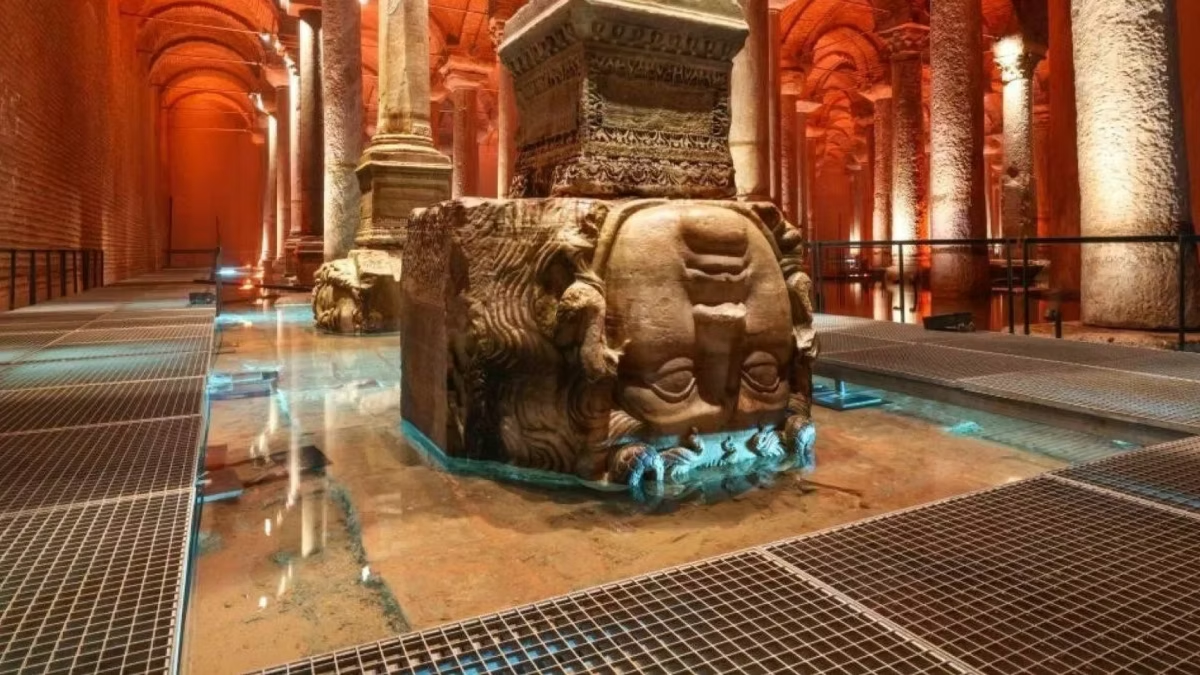
The Medusa heads at the Basilica Cistern are two carved marble blocks depicting the Gorgon Medusa, used as column bases in the northwest corner of the cistern. One is positioned upside down, the other sideways. They were rediscovered during the 1985–1987 restoration — previously buried under sediment and water. Scholarly consensus suggests they came from an earlier Roman building (most commonly proposed: the Forum of Constantine or the Forum Tauri), brought to the cistern as spolia during its 6th-century construction. Four main theories explain their unusual orientation: (1) practical — the blocks were sized to match the required column height; (2) symbolic — early Christian subordination of pagan imagery; (3) protective — neutralising Medusa’s petrifying gaze in folk tradition; (4) mundane — Byzantine builders simply treated Roman relics as construction material. No theory has definitive proof, but the first (practical sizing) is the most widely accepted among modern archaeologists.
The Medusa heads are the Basilica Cistern’s most iconic feature and probably the single most photographed objects in the entire structure. They appear in most promotional photography, in Dan Brown’s Inferno (book and film), and in countless travel guides and online articles. But their fame is somewhat disproportionate to what we actually know about them: both the origin and the reason for their unusual positioning remain unresolved archaeological puzzles.
This article covers what scholarly consensus actually says about the Medusa heads, the main theories about their origin and orientation, their mythological context, and practical tips for seeing them on a visit. All information reflects current academic understanding as of 2026.
What You’re Actually Looking At
The Medusa heads are two separate carved marble blocks, each depicting the face of the Gorgon Medusa from Greek mythology — a female figure with snakes for hair, whose gaze turned anyone who looked directly at her into stone. Both blocks serve as the bases of two specific columns in the Basilica Cistern’s far northwest corner.
The physical features:
- Both heads are carved in a classical Roman style, with detailed depictions of facial features, snake-hair, and characteristic Gorgon expression
- Each block is large — approximately 2 metres across and of significant depth, sized to support a 9-metre marble column above
- Material is marble, consistent with the classical-era spolia found throughout the cistern
- Carving quality is high, suggesting they came from an important original context rather than a low-status building
The two heads are positioned next to each other, both within a few metres of the cistern’s northwest corner — the far end of the visitor route from the entrance.
The orientation
This is what makes the Medusa heads famous:
- One head is positioned upside down — the face oriented downward, with the snake-hair sweeping upward from what would be the chin
- The other head is positioned sideways — the face oriented horizontally, looking sideways across the cistern floor rather than up or forward
Neither head is in its “natural” upright orientation. This is the single factual puzzle that has generated decades of speculation.
When the Medusa Heads Were “Discovered”
The heads weren’t discovered in 532 AD — they were placed there, deliberately, by Byzantine builders. But for roughly 1,500 years afterward, they were buried beneath sediment and water, invisible to anyone visiting the cistern.
Historical accounts of the cistern from the Byzantine, Ottoman, and early modern periods don’t mention Medusa heads. Even Petrus Gyllius, the French scholar who rediscovered the cistern in 1545 and wrote the first detailed European account of it, doesn’t describe them. This suggests the heads were already covered by sediment accumulation by the mid-16th century, if not earlier.
The Medusa heads re-emerged during the Istanbul Metropolitan Municipality’s restoration campaign between 1985 and 1987, which drained the cistern and removed approximately 50,000 tons of accumulated silt. As the sediment came out, the northwest corner was revealed to contain two carved blocks at the base of two columns — depicting the Gorgon’s face.
The discovery caused immediate excitement. Before 1987, the cistern was known primarily as Byzantine water infrastructure; after the Medusa heads were revealed, it became an archaeological icon.
Where the Medusa Heads Probably Came From
No inscription, document, or archaeological evidence definitively identifies the heads’ original source. But based on style, carving technique, and plausible provenance, scholars have proposed several candidates.
Theory 1: The Forum of Constantine (most widely accepted)
The strongest candidate is the Forum of Constantine, the major public square established by Constantine I when he refounded Byzantium as Constantinople in 330 AD. The forum sat on what is now Çemberlitaş in Istanbul, a 10-minute walk from the cistern.
Supporting evidence:
- A similar Medusa head block, stylistically comparable to the cistern’s, was discovered at the Forum of Constantine site and is now housed in the Istanbul Archaeological Museums
- Sculpture from the Forum of Constantine was widely scavenged after the forum’s decline in the late Roman period
- The forum had triumphal arches, temples, and monumental gates, any of which could have used Medusa heads as decorative elements
- Proximity — the forum was close enough to the cistern that transporting the blocks would have been straightforward
Under this theory, the heads originally decorated a triumphal arch, temple pediment, or monumental gateway within the forum, possibly as protective apotropaic symbols (Medusa was often used this way in Roman architecture — the Gorgon’s face was believed to ward off evil).
Theory 2: The Forum Tauri
An alternative proposal points to the Forum Tauri (today’s Beyazıt Square), another major Constantinople public square that contained Theodosius I’s triumphal arch. Stylistic similarities exist between some Forum Tauri fragments and the cistern’s Medusa heads.
This is also the proposed source of the Crying Column, which matches the Triumphal Arch of Theodosius in carving style. If both the Medusa heads and the Crying Column came from the Forum Tauri, that would suggest a coordinated salvage effort from that site during the cistern’s construction.
Theory 3: Pagan temple origins
Some older hypotheses suggest the heads came from a specific pagan temple — perhaps a temple of Athena (whose shield famously bore a Medusa head) or Apollo in Athens, or a Gorgoneion-decorated structure elsewhere in the Greek world. Medusa heads appear in various Greek and Roman religious architecture as apotropaic (evil-averting) symbols.
This theory is harder to substantiate because no specific temple has been linked through surviving evidence. It’s plausible but speculative.
Theory 4: Unfinished workshop pieces
A minority view proposes the heads were unfinished blocks from a Roman sculpture workshop, never installed in their intended location. This would explain the unusual positioning — builders might have used the blocks pragmatically without regard to original design intent.
This theory has less traction in current scholarship because the carving quality appears complete rather than unfinished.
What we don’t know
Even under the most likely theory (Forum of Constantine), we don’t know:
- The exact original location within the forum
- What architectural role the heads played (pediment? Arch base? Column capital? Wall decoration?)
- When they were carved — likely 1st–4th century AD, but specific dating isn’t confirmed
- How they reached the cistern — whether directly as construction salvage or via an intermediate storage period
The Four Theories About Their Orientation
Why are the heads positioned upside down and sideways? This is the puzzle that has generated the most visitor speculation and the most scholarly debate.
Theory 1: Practical sizing (most widely accepted among archaeologists)
The simplest and most commonly accepted theory among modern archaeologists is pragmatic: the heads were the right height for the required column bases.
Under this theory, Byzantine builders needed blocks of a specific height to support 9-metre columns at this specific location in the cistern. The Medusa head blocks happened to be the correct dimension when positioned upside down (one) or sideways (the other). The orientation was determined by the column sizing requirement, not by any symbolic intent.
Evidence supporting this theory:
- Byzantine builders regularly reused spolia without regard to original orientation — see the varied column capitals throughout the cistern
- The cistern was functional infrastructure, not a ceremonial space where symbolic orientation would matter
- The orientation doesn’t follow any consistent symbolic pattern — if it were ritualistic, you’d expect both heads in the same position
This theory is favoured in academic archaeology literature but is the least satisfying for tourists and storytellers.
Theory 2: Christian subordination of pagan imagery
A symbolic theory proposes that Byzantine Christian builders deliberately inverted the Medusa heads to demonstrate the Church’s triumph over pagan religion.
Under this theory:
- Medusa was a pagan Greek figure — a Gorgon from pre-Christian mythology
- Byzantine Christianity was consolidating power in the 6th century and actively converting pagan sites to Christian use
- Inverting pagan iconography was a known practice — early Christian churches sometimes placed classical statues upside down or in subordinate positions
- Placing Medusa heads in functional support roles (literally holding up the weight of the cistern) both repurposed and symbolically subjugated them
This theory has more traction in popular writing than in academic scholarship because it makes a satisfying narrative, though direct evidence for the specific intent is limited.
Theory 3: Neutralising Medusa’s gaze
A folk/popular theory suggests the heads were inverted to prevent Medusa’s petrifying gaze from affecting visitors or damaging the cistern.
Under this theory:
- Medusa’s gaze turned onlookers to stone in Greek mythology
- By orienting the heads away from direct viewing positions, builders prevented the gaze from being cast outward
- This reflects folk belief rather than official theology, possibly influenced by continuing cultural memory of Medusa’s apotropaic reputation even in Christian contexts
This is the most popularly repeated theory in tour guide narratives. It makes for an engaging story but has limited historical evidence beyond general folk tradition.
Theory 4: Indifferent builders
A cynical theory proposes that Byzantine builders simply didn’t care about the orientation — treating the Medusa heads as raw construction material rather than meaningful cultural objects. Under this view, the heads went in however they fit, with no symbolic intent at all.
As a Guardian journalist memorably put it, this interpretation treats the inversion as “proof that Byzantine builders saw Roman relics as little more than reusable rubble.”
This theory overlaps with Theory 1 (practical sizing) but emphasises the absence of cultural respect rather than the presence of engineering necessity.
What modern scholarship concludes
Most academic archaeologists today favour Theory 1 (practical sizing), sometimes combined with Theory 4 (indifference). The symbolic theories (Christian subordination, gaze neutralisation) are considered possible but unproven.
The practical reality is probably mundane: Byzantine builders picked up available marble blocks, noticed they fit the required dimensions, installed them, and moved on. What’s symbolically fascinating to us today was probably a routine construction decision to them.
Medusa in Greek Mythology: Context
Understanding why the heads are striking requires understanding who Medusa was in classical mythology:
- One of three Gorgon sisters in Greek mythology (with Stheno and Euryale)
- Originally described as beautiful, later transformed into a monster
- In some versions of the myth, she was a priestess of Athena who was raped by Poseidon in Athena’s temple, then punished by Athena with her monstrous transformation
- Hair transformed into snakes, features contorted into a horrifying expression
- Gaze turned onlookers to stone — anyone who looked directly at her was petrified
- Killed by the hero Perseus, who used a polished shield as a mirror to look at her reflection while beheading her
- After death, her head retained its petrifying power — Perseus used it as a weapon and eventually gave it to Athena, who mounted it on her shield (the Aegis)
In Roman architecture, Medusa’s head (the Gorgoneion) was commonly used as an apotropaic symbol — a protective device believed to ward off evil, the “evil eye,” and misfortune. You’ll see Medusa heads on Roman shields, armour, temple pediments, sarcophagi, and triumphal arches throughout the empire.
The cistern’s heads were likely originally intended as exactly this kind of protective architectural decoration. Their repurposing as structural column bases, whatever the builders’ intent, represents one of the most striking examples of Roman iconography transformed by Byzantine pragmatism.
What to Look For on a Visit
Practical observations for your visit:
Location
The Medusa heads are in the far northwest corner of the cistern — the opposite end from the main entrance. Follow the visitor walkway to the end; the heads are clearly marked with informational signage.
The only ground-level access point
This is worth knowing: the walkway near the Medusa heads is the only section of the visitor route where you can descend to (or near to) floor level. Everywhere else in the cistern, you’re walking on elevated modular steel walkways. Near the Medusa heads, a small platform brings you down to approximately the same level as the column bases, allowing much closer inspection than anywhere else in the cistern.
This is deliberate — the Medusa heads reward close viewing. Take advantage.
Photography
Both heads are well-lit and positioned for visitor viewing. The area can be crowded (it’s the cistern’s most visited spot), so be patient for clear-photo windows. Post-2022 restoration, the lighting is specifically designed to highlight the Medusa faces — consider visiting during the Night Shift for different atmospheric lighting.
The upside-down vs. sideways distinction
Don’t just note that the heads are “differently oriented” — actually identify which is which:
- The upside-down head has the hair/snakes emerging from the top of the block (from the original chin direction) and the face looking downward into the stone
- The sideways head has the face looking horizontally across the water, with the hair emerging from one side
These are genuinely different orientations, not slight variations. Seeing them directly reveals why archaeologists have had such difficulty explaining the positioning.
Compare to the other columns
Before leaving the area, look at the immediately surrounding columns. Most of the cistern’s 336 columns have simple plinths or impost blocks at their base — plain cubes of stone. The Medusa heads are exceptional not just for their carving but for being used at all as column bases. Their presence in this specific corner, out of 336 columns, begs the same question: why here?
Why the Medusa Heads Matter
Beyond the visual spectacle, the Medusa heads are historically significant for three reasons:
They document the transition from classical to Byzantine civilization
The heads capture a specific historical moment: the 6th century, when Byzantine Constantinople was systematically repurposing classical Roman and Greek architectural elements into new Christian infrastructure. The Medusa heads embody this transition more viscerally than any other object in the cistern.
They’re among the most complete surviving Gorgoneion sculptures
Many Gorgon heads from classical antiquity survive only as fragments. The cistern’s two heads are largely intact, high-quality carvings from the Roman period. Their preservation — accidental, because they were buried under sediment for centuries — means we have better Medusa sculptures here than in many museum collections.
They demonstrate Byzantine pragmatism
Whatever the intent behind the orientation, the Medusa heads demonstrate a particular Byzantine attitude toward the classical past: not destruction, but repurposing. The heads weren’t smashed or buried; they were incorporated into the new order, functionally subordinated but physically preserved. This pragmatic attitude is why so much classical material survives in Istanbul today.
Frequently Asked Questions
Where are the Medusa heads located in the Basilica Cistern?
In the far northwest corner of the cistern, as column bases for two specific columns. They’re at the end of the visitor walkway, opposite the main entrance.
When were the Medusa heads discovered?
During the Istanbul Metropolitan Municipality’s restoration between 1985 and 1987. Previously, they had been buried under sediment and water for centuries.
Are they real Roman antiquities?
Yes. The heads are classical-era Roman carvings (likely 1st–4th century AD) that were reused as column bases when the cistern was built in the 6th century.
Why is one head upside down?
No definitive answer. The most widely accepted scholarly theory is practical — the block was sized to match the required column base height when placed upside down. Symbolic theories (Christian subordination of pagan imagery, neutralising Medusa’s gaze) are possible but unproven.
Why is the other head sideways?
The same range of possible explanations applies — most likely practical sizing, possibly symbolic intent.
Where did the Medusa heads come from?
Scholarly consensus favours the Forum of Constantine (Çemberlitaş area) as the most likely original source, based on stylistic similarities with other Medusa-head blocks found at that site. The Forum Tauri (Beyazıt Square) is an alternative candidate.
Were the heads carved specifically for the cistern?
No. They’re spolia — reused architectural elements from earlier Roman buildings. The carving predates the cistern by decades or centuries.
Can I touch the Medusa heads?
No. Touching is prohibited for conservation reasons. The viewing platform near the heads brings you close but not directly to the stone surface.
Are photos allowed?
Yes, without flash. The Medusa heads are among the cistern’s most photographed features.
How does Medusa relate to the cistern’s Byzantine Christian context?
Medusa was a pre-Christian pagan figure. Her appearance in a Byzantine Christian infrastructure reflects the widespread 6th-century practice of reusing classical materials — whether pragmatically, symbolically, or indifferently.
Are there other Medusa heads in the Basilica Cistern?
No. Only the two in the northwest corner. The cistern’s other 334 columns have standard plinths or impost blocks rather than figural bases.
Do the Medusa heads appear in films or books?
Yes — they feature prominently in Dan Brown’s Inferno (2013 novel and 2016 film), Assassin’s Creed: Revelations (2011 video game), and numerous documentaries. Their visual distinctiveness makes them a go-to location for Istanbul-set thrillers. For more, see our film and literature article.
