
Basilica Cistern FAQs — Tickets, Hours, Visit Tips (2026)
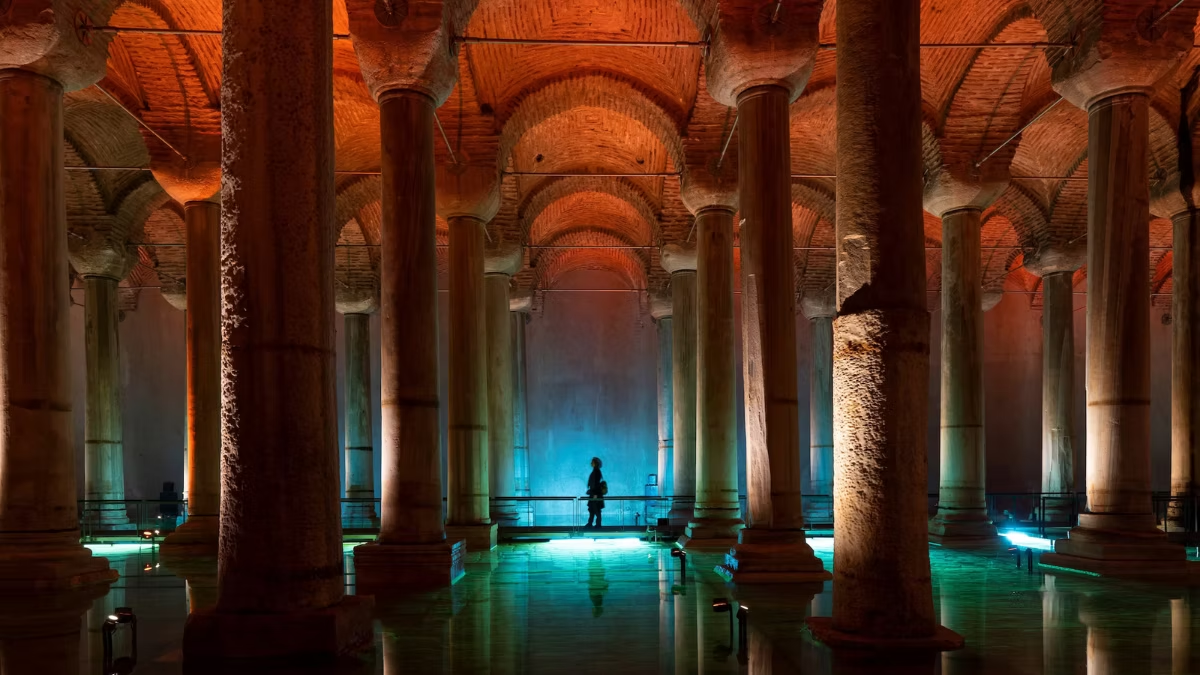
The Basilica Cistern is Istanbul’s largest Byzantine underground reservoir, built in 527–542 AD by Emperor Justinian I, now operating as a museum in the Sultanahmet district. In 2026, it’s open daily 09:00–18:30 with a separate Night Shift programme 19:30–22:00. Daytime entry is 1,950 Turkish Lira (about €45) and Night Shift is 3,000 TL (about €70); the Istanbul Museum Pass is NOT valid. A typical visit takes 45–75 minutes. Key features: 336 marble columns, two Medusa-head column bases, the Crying Column, and shallow water with resident carp. The cistern is open 365 days a year. Cash is not accepted — card and Istanbulkart only. Nearest tram: Sultanahmet (T1), 3-minute walk. Book skip-the-line tickets online in advance during peak season (May–September).
This is the central FAQ hub for everything you might want to know about visiting the Basilica Cistern in 2026. If you need a quick answer, find your question below; if you want more depth on any topic, each answer links to the full article covering that subject.
Questions are grouped by category: tickets and prices, hours and timing, getting there, what to see, practical logistics, and accessibility. Every factual detail has been verified against 2026 operator information. Prices are TL-denominated and can shift with exchange rates — double-check before you travel.
Tickets and Prices
How much does it cost to visit the Basilica Cistern in 2026?
Daytime entry is 1,950 Turkish Lira per adult foreign visitor (approximately €45 / US$55 / £37). The Night Shift experience (19:30–22:00) costs 3,000 TL (approximately €70). An audio guide is 300 TL extra on-site. Full breakdown in our tickets and prices guide.
Is the Istanbul Museum Pass valid at the Basilica Cistern?
No. The Basilica Cistern is operated by Kültür AŞ (Istanbul Metropolitan Municipality), not the Turkish Ministry of Culture, and the Museum Pass does not cover it. You need a separate ticket. See our official website guide.
Where's the best place to buy tickets?
Online in advance is recommended — the on-site queue regularly runs 30–60 minutes in peak season. Our how to book guide covers online platforms, the official site, and on-site options.
Do I need a skip-the-line ticket?
Strongly recommended May–September and on weekends year-round. See our skip-the-line guide for when it’s worth paying extra.
Is it worth getting a combo ticket with other attractions?
Depends on your itinerary. Combos pair the cistern with Hagia Sophia, Topkapí Palace, or Dolmabahçe and typically save €10–20 versus buying separately. Full comparison in our combo tickets guide.
Should I pick a guided tour or an audio guide?
Guided tours (€20–40) offer live commentary and deeper context; audio guides (€5–10 included or added) are flexible and self-paced. Our guided vs audio comparison helps you choose.
Are there discounts for students, seniors, or children?
Turkish citizens aged 65+ enter free. Under-7s enter free. No student discount for foreign visitors. Disabled visitors + 1 companion enter free. Children 7+ pay the full adult rate. Details in our prices guide.
Can I pay with cash?
No. The cistern has been cashless since 2022. Card payments and Istanbulkart only — no Turkish lira cash, no foreign currency.
What's the Night Shift and is it worth the extra cost?
The Night Shift (19:30–22:00) offers atmospheric lighting, reduced crowds, and occasionally live music or performances. At 3,000 TL vs 1,950 TL, it’s 54% more expensive but significantly quieter. Full review in our Night Shift audio guide review and night visit guide.
Hours and Timing
What are the Basilica Cistern's opening hours in 2026?
Daytime: 09:00–18:30 daily. Maintenance/session change: 18:30–19:30 (closed to visitors). Night Shift: 19:30–22:00 daily. Full timing breakdown in our opening hours guide.
Is the Basilica Cistern open every day of the year?
Yes — 365 days, including public holidays and religious festivals. Unlike Hagia Sophia (closed Friday afternoons for prayer) or Topkapí (closed Tuesdays), the cistern has no weekly closure.
What's the best time of day to visit?
09:00–10:30 is least crowded; 16:30–18:30 is the second-best window as daytime crowds thin. Midday (11:00–14:00) is peak crowd time, especially weekends and peak season. Full timing strategy in our opening hours guide.
How long does a typical visit take?
45–75 minutes for most visitors. Minimum 30 minutes for a quick walk-through; up to 2 hours if you’re using the audio guide thoroughly or doing photography. Detailed time-planning in our how long to visit guide.
Can I stay as long as I want inside?
Yes, until closing time. There’s no time limit per visitor within a session.
When's the quietest season?
November–March is low season. May–September is peak. Off-season visits avoid the summer queues entirely — often no skip-the-line advantage is needed in winter.
Getting There
How do I get to the Basilica Cistern?
The nearest public transport stop is Sultanahmet tram station on the T1 line, a 3-minute walk from the entrance. From Taksim/Beyoğlu, take the F1 funicular to Kabataş, then the T1 tram to Sultanahmet. Full directions in our how to get there guide.
What's the exact address?
Alemdar Mah. Yerebatan Cad. 1/3, 34410 Sultanahmet-Fatih, Istanbul. Phone: +90 212 512 15 70.
Can I walk from Hagia Sophia or the Blue Mosque?
Yes — the cistern is 3 minutes on foot from Hagia Sophia and 5 minutes from the Blue Mosque. It’s the most walkable major attraction in Sultanahmet.
Is there parking nearby?
Sultanahmet is largely pedestrianised. The closest car park is the Archaeological Museum car park (~8-minute walk), but driving into Sultanahmet is strongly discouraged. Our how to get there guide covers all transport options.
Can I take a taxi?
Yes, but taxis can’t enter the pedestrian zone. Drivers will drop you near the tram station or the Blue Mosque, a 3–5 minute walk to the cistern.
How far from Istanbul Airport?
Approximately 50 km / 45–90 minutes depending on traffic. Options: HAVAIST bus to Taksim (~2 hours) then tram to Sultanahmet, or taxi (~600–900 TL / €14–21).
What to See Inside
What are the Medusa heads?
Two carved marble blocks depicting the Gorgon Medusa, used as column bases in the cistern’s northwest corner. One is upside down, the other sideways. Full background in our Medusa heads article.
Why are the Medusa heads positioned upside down and sideways?
No definitive answer. The most accepted theory is practical — the blocks were sized to match the required column base height in those orientations. Symbolic theories (Christian subordination of pagan imagery, neutralising Medusa’s gaze) also exist. See our Medusa heads article for all theories.
What's the Crying Column?
A single column with distinctive raised carvings of teardrops, eye patterns, and slanted branches — also called the Hen’s Eye Column or Weeping Column. Tradition connects it to the roughly 7,000 enslaved labourers who died during construction. Full story in our Crying Column article.
Are there still fish in the cistern?
Yes — primarily carp, visible in the shallow water below the walkways. Look near walkway edges where water is deepest. The population has been present since at least 1545. Full background in our fish in cistern article.
How many columns are there?
336 marble columns, arranged in 12 rows of 28, each approximately 9 metres tall. Most are spolia (reused from older Roman and Greek buildings). Deep dive in our columns article.
Are the columns original to the cistern?
Yes — all 336 are original 6th-century (or earlier) marble columns installed during the cistern’s construction. However, most are older than the cistern itself, reused from Roman buildings.
What art installations are inside?
Following the 2022 restoration, the cistern hosts permanent and rotating contemporary art installations under the “Daha Derine” (Deeper Beneath) exhibition programme. Full list of artists and works in our art installations article.
Which films were filmed at the Basilica Cistern?
Notable appearances include From Russia With Love (1963), Inferno (2016), The International (2009), Brotherhood of Tears (2013), Assassin’s Creed: Revelations (video game, 2011), and Age of Empires IV. Full catalogue in our film and literature article.
How old is the Basilica Cistern?
Built between 527 and 542 AD under Byzantine Emperor Justinian I, making it roughly 1,500 years old. It has functioned continuously (in various forms) since then. Full history in our history article.
Why is it called the Basilica Cistern?
It takes its name from the Stoa Basilica, a large Roman civic building (3rd–5th century) that stood directly above it. “Basilica” means civic hall, not church. Full background in our history article.
Are there other Byzantine cisterns to visit in Istanbul?
Yes — most notably the Şerefiye (Theodosius) Cistern and Binbirdirek (1,001 Columns) Cistern, both visitable, less crowded, and cheaper than the Basilica Cistern. Our other cisterns article covers all visitable Byzantine cisterns in Istanbul.
Practical Visit Logistics
How many steps to enter?
52 stone steps at the main entrance. For step-free access, use the Alemdar Street exit which has a wheelchair lift. Details in our accessibility guide.
Is the Basilica Cistern accessible for wheelchair users?
Partially. The main entrance has 52 steps (no lift), but the Alemdar Street exit has a wheelchair lift that can also be used for entry. Internal walkways are step-free and wide. Full accessibility breakdown in our accessibility guide.
Is it safe for children?
Yes — but the cistern is dark, echoing, and humid (96% humidity), and some children find it atmospheric while others find it unsettling. Children under 15 must be accompanied. Full guidance in our visiting with kids guide.
What should I wear?
Comfortable flat shoes with good grip (floor can be wet and slippery). Light jacket even in summer — interior is 16–18°C year-round vs. Istanbul’s 25–35°C summer heat. Avoid high heels. Full wardrobe guidance in our what to wear guide.
Can I take photos?
Yes, without flash. Tripods and professional equipment require prior permission. Full photography rules in our photography guide.
Is flash photography allowed?
No. Flash is prohibited for conservation reasons and because it disturbs other visitors in the atmospheric lighting.
Can I bring a tripod?
Tripods aren’t allowed without advance permission from Kültür AŞ. Commercial photography permits require separate application. See our photography guide.
What's the temperature inside?
16–18°C year-round, with 96% humidity. Noticeably cool and damp compared to Istanbul’s seasonal temperatures. Dress for the interior, not the weather outside.
Are food and drinks allowed?
No. No food, no drinks, no smoking (including e-cigarettes). No large luggage or suitcases.
Are pets allowed?
No. Service animals may be permitted with prior arrangement.
Are there toilets inside?
No toilets inside the cistern itself. Public toilets are available in nearby Sultanahmet cafés and the Sultanahmet Park area. Use the facilities before entering.
Is there a cloakroom?
No. Small bags and backpacks are allowed but large luggage is prohibited. Plan to store big items at your hotel or at the Sultanahmet train station.
Is there Wi-Fi or mobile signal inside?
Signal is very limited underground. Download audio guide content before you descend — the official audio guide app provides offline content that works without signal.
Can I re-enter if I leave?
No — tickets are single-entry. Plan your visit to cover everything in one continuous session.
Accessibility and Special Needs
Is the main entrance accessible for wheelchairs?
No — 52 steps at the main entrance with no lift. Use the Alemdar Street exit entrance, which has a wheelchair lift. Full routing in our accessibility guide.
Does the Alemdar Street entrance always work?
The wheelchair lift is staff-operated and occasionally delayed if multiple wheelchair users arrive simultaneously. Wait times can be up to 30 minutes in peak season.
Are there audio descriptions for visually impaired visitors?
Not currently offered. The standard audio guide describes what visitors are seeing but isn’t specifically designed for visually impaired access. Contact Kültür AŞ in advance for special accommodations.
Is the cistern accessible for visitors with mobility limitations?
Partially. Interior walkways are step-free and relatively wide, suitable for wheelchairs and walking frames. The Alemdar Street lift provides step-free entry. See our accessibility guide.
Can I bring a pushchair/stroller?
Pushchairs are allowed but the 52-step main entrance is impractical — use the Alemdar Street lift. Internal walkways accommodate pushchairs, though crowding at the Medusa heads can be tight.
Nearby Attractions and Food
What else is nearby?
Hagia Sophia (3 min walk), Blue Mosque (5 min), Topkapí Palace (8 min), Grand Bazaar (12 min), Sultanahmet Square, Hippodrome. Full coverage in our nearby attractions guide.
Where should I eat before or after my visit?
Sultanahmet has extensive dining from budget kebab shops to high-end restaurants. Our where to eat guide covers specific restaurant recommendations near the cistern.
Can I do the cistern and Hagia Sophia in one day?
Easily. They’re 3 minutes apart. Budget 60–90 minutes for the cistern and 60–120 minutes for Hagia Sophia. Many combo tickets pair them — see our Hagia Sophia combo guide.
Is the Blue Mosque walkable from the cistern?
Yes, 5 minutes on foot. The Blue Mosque is free to enter but closes during prayer times. See our Blue Mosque + Cistern combo guide for combined visit strategies.
Can I do cistern-hopping in one day?
Yes — visit the Basilica Cistern, the Şerefiye Cistern, and the Binbirdirek Cistern all within a 10-minute walking circle. Full itinerary in our other cisterns article.
Safety, Comfort, and Etiquette
Is the cistern safe?
Yes. It’s a well-managed, well-lit (by cistern standards), heavily-visited heritage site. Standard travel caution applies — watch for slippery floors and low railings in dark areas.
Is the floor slippery?
The modular steel walkways can be slightly damp but aren’t dangerously slippery. Wear shoes with good grip. Avoid running or horseplay.
Can I touch the columns?
No. Touching heritage surfaces is prohibited for conservation reasons. The Medusa heads and Crying Column are behind viewing barriers.
Can I throw coins into the water for luck?
No. Throwing anything into the water is prohibited — coins damage the water quality and disturb the fish population.
What's the dress code?
None specific to the cistern. Modest dress isn’t required (unlike for mosques). Dress comfortably for cool, humid conditions.
Are there crowds inside?
Peak season (May–September) and weekends see significant crowding, especially around the Medusa heads where people bottleneck. Morning opening and late afternoon are calmer. Full crowd-management strategy in our opening hours guide.
Can I bring my phone?
Yes, but protect it from water droplets (96% humidity + occasional ceiling drips). Flash photography is prohibited; general photography is fine.
Practical Worth-It Questions
Is the Basilica Cistern worth visiting?
For most Istanbul visitors, yes — it’s visually striking, historically unique, and unlike anything else most people will see elsewhere. Full discussion (including honest counter-arguments) in our is it worth it guide.
How does it compare to other Istanbul attractions?
It’s shorter than Topkapí (45–75 min vs. 3–4 hours), more atmospheric than Hagia Sophia’s current state (Upper Gallery only post-2020), and more spectacular than the other visitable cisterns. See our is it worth it guide for full comparisons.
Is the audio guide worth the extra 300 TL?
For most first-time visitors yes — the cistern’s history isn’t obvious from visual inspection alone. If you’re doing a self-guided visit without a live guide, the audio guide is strongly recommended. Our guided vs audio guide covers the comparison.
Is a guided tour worth it?
Worth it if you want context on Byzantine history, the Medusa theories, and the columns’ origins — hard to extract fully from signage or audio alone. Our guided vs audio guide and guided tour review help you decide.
Can I skip the Basilica Cistern if I'm short on time?
If your Istanbul time is under 48 hours and you haven’t seen Hagia Sophia, Blue Mosque, or Topkapí, prioritise those first. The cistern is a strong “tier 2” attraction — memorable but not essential if time is extremely tight. Our is it worth it guide covers the prioritisation question.
Booking and Planning
How far in advance should I book tickets?
Peak season (May–September): 1–3 days ahead for skip-the-line availability. Off-season: same-day booking is usually fine. Night Shift availability is sometimes limited on event evenings — book 3–7 days ahead if you want a specific date.
Can I cancel or change my booking?
Most online platforms offer 24-hour free cancellation. Check your specific booking’s cancellation policy. See our how to book guide for platform-specific policies.
What if I book for the wrong day or time?
Contact the platform where you booked. Most allow free rescheduling within 24 hours of the original date. After that, re-booking fees may apply.
Do children need separate tickets?
Under-7s enter free — most platforms offer a free child ticket at booking for headcount. Children 7+ pay the adult rate.
Can I book for a group?
Yes — most platforms offer group bookings for 10+ people. Kültür AŞ also offers direct group bookings via the official website. See our how to book guide.
Do I need to print my ticket?
No. QR codes on your phone work at the entrance. Screenshot the QR code as backup in case the app fails.
What languages is the audio guide in?
English, French, German, Spanish, Italian, Russian, Turkish, plus additional languages through combo audio guides (up to 25 languages in some combo products).
Is there a family pass or multi-day pass?
No cistern-specific family pass. The Istanbul Tourist Pass and Istanbul MegaPass include the Basilica Cistern as part of multi-attraction bundles — worth evaluating if you’re visiting 4+ paid sites. See our combo tickets guide.
Miscellaneous
What's the Turkish name for the Basilica Cistern?
Yerebatan Sarnıcı (literally “Sunken Cistern”) or Yerebatan Sarayı (“Sunken Palace”). The Turkish names are used interchangeably by locals.
Is the cistern haunted?
No credible reports, despite the atmospheric setting. Its appearance in thrillers and horror-adjacent film settings is about the visual atmosphere, not any actual supernatural reputation.
Are there underground tunnels connecting to other sites?
Rumours persist of secret tunnels to Topkapí Palace or Hagia Sophia. No such tunnels have been confirmed archaeologically. The cistern’s actual structural connections are through the Byzantine aqueduct system, not direct tunnels.
Why is the cistern so humid?
96% humidity is maintained by the shallow water, 1,500-year-old waterproof mortar walls, and underground location. The humidity is part of the authentic experience — don’t expect it to be reduced.
Has the cistern ever flooded?
The cistern is designed to hold water — it’s essentially a giant reservoir. Water levels are deliberately kept low (30–50 cm) for visitor access. No modern flooding events have affected visitors.
Is there a gift shop?
Yes, at the exit area. Standard heritage site merchandise — books, postcards, magnets, replica Medusa heads. Quality varies; prices are tourist-rate.
Can I propose or hold a private event at the Basilica Cistern?
Private events including proposals and small ceremonies can be arranged with Kültür AŞ. Standard visitor access doesn’t include private-event rights. Contact the cistern directly for event bookings.
What language do staff speak?
Turkish and English primarily. Some staff speak additional languages (Arabic, Russian, German). Signage is in Turkish and English.
Is there a lost and found?
Contact the cistern directly (+90 212 512 15 70) if you lose something. Items are typically held at the main ticket office for 30 days.
Does the cistern have a social media presence?
Yes — the official accounts are run by Kültür AŞ and post updates on Night Shift events, temporary exhibitions, and operational changes. Follow for the latest programming.
