
The 336 Columns of the Basilica Cistern: Roman Spolia Beneath Istanbul
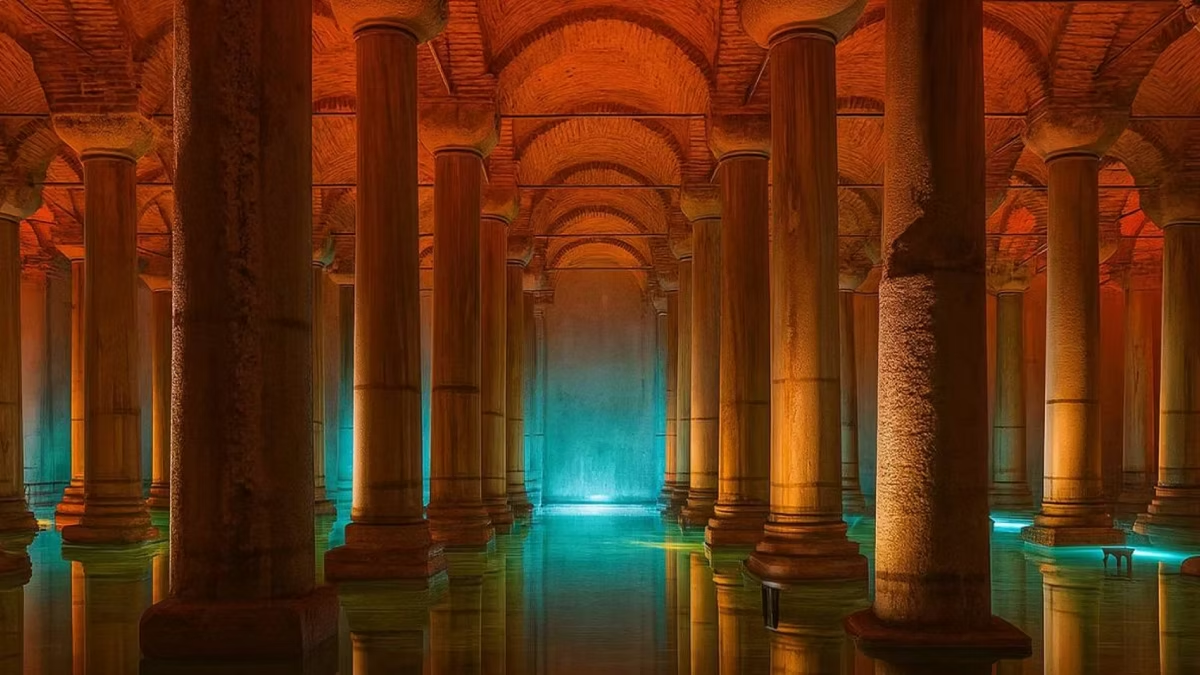
The Basilica Cistern’s interior is supported by 336 marble columns, each approximately 9 metres (30 feet) tall, arranged in a strict grid of 12 rows of 28 columns, spaced roughly 4.8 metres apart. Most columns are spolia — reused from older Roman and Greek structures across the Byzantine Empire, rather than purpose-carved for the cistern. Column capitals display a mix of Corinthian (most common), Ionic, and Doric styles, revealing their varied origins. The distinctive Medusa head bases in the northwest corner and the single carved Crying Column (Hen’s Eye Column) are the most celebrated individual columns, but the 334 “ordinary” columns are themselves an unintentional museum of classical-era architecture.
The Basilica Cistern’s 336 columns are the single most visually striking feature of the interior — the “forest of marble” that gives the space its cathedral-like quality. But they’re also historically remarkable in a way most visitors don’t immediately register: these columns weren’t carved for the cistern. They were collected from across the Roman and Greek world, dismantled from temples, forums, and public buildings that had been abandoned, damaged, or deemed redundant by the 6th-century Byzantine state. Walking the cistern is, in effect, walking through a partial museum of classical column-carving traditions.
This article covers the columns systematically: their physical specifications, their spolia origins, the mix of architectural styles on display, the grid arrangement and its structural logic, and the handful of specifically notable individual columns worth finding during a visit. The Medusa heads and the Crying Column have their own dedicated articles linked at the end.
The Basic Numbers
- Total columns: 336
- Arrangement: 12 rows × 28 columns
- Column height: approximately 9 metres (30 feet) each
- Column spacing: approximately 4.8 metres (16 feet) between columns
- Material: predominantly marble, with some limestone variants
- Column construction: mostly single-shaft columns; some use two stacked drums to reach the required 9-metre height
- Orientation: rows run parallel to the cistern’s long axis (west-to-east)
The arithmetic is exact: 12 × 28 = 336. The grid is so rigorous that from almost any position inside the cistern, you can sight long colonnades running in both directions — the visual effect that gives the space its “sunken palace” nickname (Yerebatan Sarayı in Turkish).
What “Spolia” Means and Why It Matters
The single most important fact about the Basilica Cistern’s columns is that they are spolia — reused architectural elements salvaged from earlier buildings. The Latin word spolia literally means “spoils” or “loot” (as in “spoils of war”), but in architectural-history usage it refers to the deliberate practice of removing materials from existing structures and incorporating them into new construction.
Spolia was common in the late Roman and Byzantine periods for several reasons:
Economic
Quarrying, transporting, and carving new 9-metre marble columns was extraordinarily expensive. Marble quarries in Proconnesus (modern Marmara Island), Thasos, and Asia Minor produced the raw material, but transporting finished columns to Constantinople and carving capitals in situ would have cost Justinian’s administrators enormously. Reusing existing columns was far cheaper.
Practical
By the 6th century, Constantinople was surrounded by Roman-era buildings that had fallen out of use. Temples of pagan gods were increasingly abandoned as the empire became Christian. Forums and public buildings damaged in fires and earthquakes were no longer worth rebuilding. The columns sitting in these derelict structures were, in effect, free raw material — if you could dismantle and transport them.
Symbolic
Reusing classical Roman and Greek architectural elements in Christian buildings demonstrated continuity with the classical past while simultaneously subordinating pagan heritage to Christian purposes. A Corinthian column from a temple of Athena, incorporated into a Christian emperor’s water reservoir, physically enacted the triumph of Byzantine Christianity over the pre-Christian world. This was ideology embedded in stone.
Available after the Nika Riots
The catastrophic Nika Riots of January 532 — which destroyed much of central Constantinople — left enormous quantities of damaged marble at hand just as Justinian’s reconstruction programme was beginning. The Basilica Cistern was built from 532 onwards; the timing was perfect for using spolia from the ruined city.
Where the Columns Probably Came From
Scholars have never compiled a definitive origin map for all 336 columns — the evidence simply doesn’t survive. But patterns in the stone, capital styles, and column proportions suggest:
- Local Constantinople structures damaged or destroyed in the Nika Riots — the Stoa Basilica itself (above the cistern), the first Hagia Sophia, the Augustaion, the Senate building
- Pre-Christian pagan temples in and around Constantinople, many in disuse by the 6th century
- Roman-era forums and public buildings across Anatolia (modern Turkey) and Greece
- Asia Minor cities like Ephesus, Pergamon, and Aphrodisias, which had large marble buildings in decline by the 6th century
- Possibly further afield — Greek mainland sites, though transport costs would have been high
Some columns show evidence of having been carved in different centuries. A typical Corinthian column in the cistern might have been originally carved in the 2nd century AD for a Roman forum, removed in the 5th century after abandonment, stored or reused in another context, and finally installed in the cistern in the 530s. Each column carries a multi-century provenance history that’s now impossible to fully reconstruct.
The Three Classical Orders on Display
The cistern’s columns display capitals in all three main classical architectural orders — the visual codes used throughout Greco-Roman architecture to signal style and hierarchy.
Corinthian (most common in the cistern)
- Most ornate and decorative of the three classical orders
- Capitals feature acanthus leaves — stylised representations of a Mediterranean plant with deeply serrated leaves
- Often include volutes (spiral scrolls) at the corners
- Emerged in 5th-century BC Greece, popularised by the Romans
- In the cistern: the majority of columns have Corinthian-style capitals, reflecting the style’s popularity in late Roman and early Byzantine buildings
The Corinthian columns give the cistern much of its decorative richness. Under the 2022 restoration’s lighting, the acanthus leaves carved 1,500+ years ago cast intricate shadows that make each column feel like individual sculpture rather than undifferentiated infrastructure.
Ionic (second most common)
- More austere than Corinthian but still ornamented
- Capitals feature paired volutes on the front and back faces
- Columns have more slender proportions
- Originated in Ionia (western Asia Minor) in the 6th century BC
- In the cistern: a substantial minority of columns use Ionic-style capitals
The Ionic columns are often older than the Corinthian ones — some dating from earlier Roman periods when Ionic was the dominant public-building style. Their paired volutes give them a distinctive, symmetrical look different from the Corinthian’s botanical ornament.
Doric (least common)
- Simplest and oldest of the three classical orders
- Capitals are plain or minimally decorated, often just a square abacus over a rounded echinus
- Columns are stockier in proportion
- Originated in mainland Greece in the 7th century BC
- In the cistern: a few Doric capitals appear, often with no decoration at all
The Doric columns reveal themselves only on close inspection — from a distance they can look like undecorated replacements. They’re genuine classical-era work, typically from older and less prestigious Roman public buildings.
The mixed effect
Walking the cistern, you can play a kind of architectural-history game: identify which columns use which order, then speculate on where they came from. A heavily-ornate Corinthian capital probably came from a high-status imperial building; a simple Doric capital probably came from a functional public structure. The collective effect creates what has been called “an unintentional museum of classical column types” — an outcome Justinian’s builders almost certainly didn’t plan, but which modern visitors can genuinely enjoy.
The Grid Arrangement: Structural Logic
The 12-by-28 grid isn’t arbitrary — it’s a structural system optimised to carry the brick vaulted ceiling above while holding back enormous ground pressure.
The vault system
Above each column capital sits a large stone impost block. From each impost, four brick barrel vaults spring in the four cardinal directions, meeting the vaults from neighbouring columns to form cross vaults (groin vaults) across the ceiling. This grid of intersecting vaults:
- Distributes ceiling weight across all 336 columns evenly
- Provides redundancy — if any single column cracks or settles, the ceiling’s load can redistribute to neighbours
- Resists lateral thrust — the vaults’ horizontal forces cancel each other out at the intersections
- Uses relatively thin brickwork — because the load is distributed, each vault can be relatively light
The wall thickness
The cistern’s perimeter walls are approximately 4 metres thick (some sources cite 4.8 metres). This enormous thickness isn’t structural overkill — it’s doing two jobs:
- Holding back soil pressure from the surrounding ground
- Waterproofing — the hydraulic mortar mix (called “khorasan” or “horasan”) on the interior wall face sealed against water loss
The combination of thick walls, the 336-column grid, and the vaulted ceiling creates a structure that has survived 1,500 years of earthquakes, sieges, Ottoman construction overhead, and modern urban development without catastrophic failure.
Notable Individual Columns
A few specific columns deserve attention on your visit:
The Medusa Heads (columns in the northwest corner)
Two columns in the far northwest corner rest on Medusa head bases — carved blocks depicting the Gorgon’s face. One is placed upside down, the other sideways. These are among the cistern’s most photographed features and the centrepiece of most audio-guide tours. Theories about why they’re positioned this way range from practical (they fit the required height) to symbolic (Christian subordination of pagan imagery). We cover this in depth in our dedicated Medusa heads article.
The Crying Column (Hen’s Eye Column)
A single column on the east side of the cistern is distinctively carved with teardrop-shaped motifs, slanted branches, and peacock-eye patterns. Tradition links this column to the 7,000 slaves said to have died during the cistern’s construction — the “crying” column weeping for the lost workers. The carving pattern resembles that of the 4th-century Triumphal Arch of Theodosius I in today’s Beyazıt Square. Full coverage in our Crying Column article.
Two-drum stacked columns
A small number of columns use two stacked drums rather than a single shaft to reach the full 9-metre height. These reveal the pragmatic adjustments Byzantine builders made when available spolia didn’t perfectly match their needs — when a salvaged column was slightly too short, they could add a second drum to reach the required ceiling height. Look for visible horizontal joints in the column shafts.
Fluted versus smooth shafts
Some columns have fluted shafts — vertical grooves running their length, a classical Greek detail dating to the 5th century BC. Others are perfectly smooth cylindrical drums. The difference reveals the diversity of original sources: fluted columns typically came from earlier, more prestigious buildings; smooth columns tended to come from later Roman-era structures where fluting had fallen out of fashion.
Material variations
Most columns are made from Proconnesian marble (from Marmara Island, near Constantinople), which has a distinctive grey-white colouration with subtle veining. A minority use different marbles — Thasian marble (whiter), cipollino (green-veined), or occasionally limestone variants. Under the cistern’s lighting, these material differences are subtle but visible to careful observers.
How to Appreciate the Columns on a Visit
Practical suggestions for getting more out of your column-watching:
- Walk the full perimeter first, then the interior. The perimeter reveals the cistern’s scale; the interior reveals column individuality
- Bring or rent an audio guide. The standard audio content covers column origins and order identification — hard to pick up on your own
- Look up at the capitals. Low lighting makes this less automatic than you’d expect; deliberate upward glances reward close inspection
- Compare neighbouring columns. Even adjacent columns often differ in stone type, capital style, and shaft treatment
- Photograph columns from low angles. The 9-metre height plus capital detail is visually striking from a squatting position; many of the cistern’s best photos use low perspective
- Don’t rush the Medusa heads and Crying Column. They justify longer dwell time than most visitors give them
- Visit the Night Shift if possible — atmospheric lighting reveals column details differently than daytime visits. See our Night Shift guide
- Bring a phone with the flashlight. Don’t actually use flash photography (prohibited), but a phone torch can reveal carved details on specific columns
Why the Columns Matter Historically
Beyond their aesthetic appeal, the 336 columns represent something historically unusual: direct physical continuity from classical antiquity to modern Istanbul.
Most ancient marble columns from the Roman and Greek worlds have either been destroyed, dispersed to museum collections, or reduced to fragments. The Basilica Cistern’s columns are still standing in the positions Justinian’s builders placed them in 1,500 years ago, carrying the same brick ceiling they were installed to support. Some of these columns were already 300–500 years old when they went into the cistern — meaning the oldest may date to the early Roman imperial period, around 1–2 AD.
Walking among them, you’re walking among objects that have witnessed the transition from pagan Rome to Byzantine Christianity to Ottoman Islam to modern Turkey. Few other places in the world offer that kind of direct continuity across 20 centuries in a single visitable interior.
Frequently Asked Questions
How many columns are in the Basilica Cistern?
336 marble columns, arranged in 12 rows of 28 columns each.
How tall are the columns?
Approximately 9 metres (30 feet) each.
Why are the columns different styles?
Because they’re spolia — reused from older Roman and Greek buildings rather than purpose-carved for the cistern. Different original sources mean different capital styles, proportions, and carving traditions.
What does “spolia” mean?
Spolia (Latin for “spoils”) refers to architectural elements reused from older buildings in new construction. It was common practice in late Roman and Byzantine architecture for economic, practical, and symbolic reasons.
Are all the columns marble?
Predominantly yes, though some limestone variants exist. Most marble columns are Proconnesian (from Marmara Island) with a grey-white colouration; a few use Thasian or other marble types.
Which is the most famous column?
The two Medusa head columns in the northwest corner are the most famous — one placed upside down, the other sideways. The Crying Column (Hen’s Eye Column) with its distinctive teardrop carvings is a close second.
How old are the columns?
The cistern itself dates to 527–542 AD, but because the columns are spolia, many are older than that — potentially dating to the 2nd or 3rd century AD or even earlier. The oldest columns may be roughly 2,000 years old.
Can I touch the columns?
Touching is not recommended for conservation reasons — the columns are actively protected heritage objects. Leaning, sitting, or climbing on any column or railing is prohibited.
Are there exactly 336 columns, or is that approximate?
Exactly 336, verified by multiple surveys. The 12-by-28 grid is precise.
What are the columns’ capitals made of?
Same stone as the shaft in most cases — marble. A few Doric capitals are simpler or plainer stone.
Why did Justinian use spolia instead of new columns?
Cost, speed, and symbolism. New 9-metre marble columns would have been prohibitively expensive for a utilitarian reservoir; reusing existing columns was the practical choice. Symbolically, incorporating classical pagan elements into a Christian emperor’s infrastructure demonstrated continuity with (and dominance over) the pre-Christian past.
Are any columns replicas?
No — all 336 columns are original 6th-century or earlier marble, installed during the cistern’s Byzantine construction. The 2022 restoration preserved rather than replaced the original columns.
