
Art Installations at the Basilica Cistern: Contemporary Exhibitions Underground
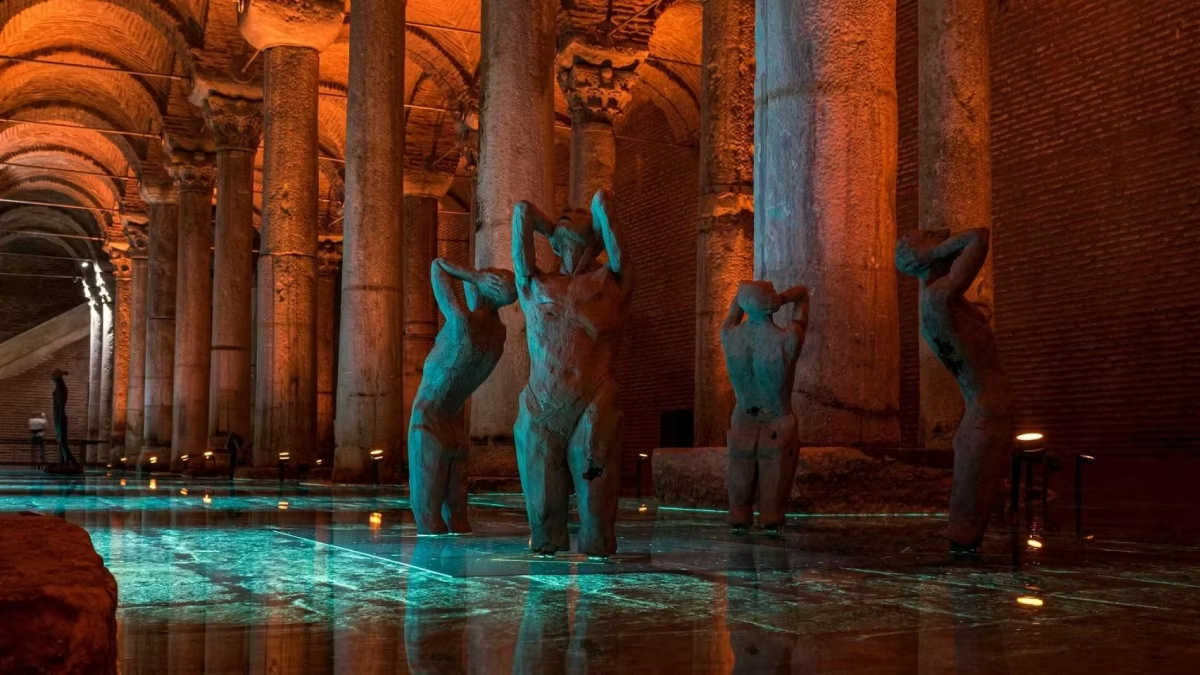
Following the comprehensive 2020–2022 restoration, the Basilica Cistern reopened with permanent and rotating contemporary art installations integrated into the Byzantine space. The flagship exhibition is “Daha Derine” (“Deeper Beneath”), featuring works by artists including Jennifer Steinkamp (American digital artist), Ali Abayoğlu, Aslı İrhan, Ozan Ünal, Yasemin Aslan Bakiri, Berkay Buğdan, Malik Bulut, Güneş Terkol, and Muzaffer Tuncer. Installations use projection mapping, sculpture, light, and video to explore themes of memory, mythology, and water. A 360-degree video-mapping experience by art collective Decol narrates the cistern’s history from construction to present. All artworks are non-invasive — mounted on reversible infrastructure added during restoration to preserve the Byzantine fabric. Rotating temporary exhibitions supplement the permanent collection, with past shows including crystal sculptures by Czech artists Vlastimil Beránek and Jaroslav Prošek.
The Basilica Cistern’s 2022 reopening changed the site’s identity in a way that goes beyond restoration. Before closing in 2017, the cistern was primarily an archaeological monument — a Byzantine space where visitors came to see ancient architecture. When it reopened in July 2022, it had become something more unusual: a historic space actively programmed as a contemporary art venue, with sculptures, projections, and installations integrated into the 1,500-year-old interior.
Whether this transformation is an enhancement or a distraction depends on your tastes. For visitors interested in contemporary art, the cistern has become one of Istanbul’s most atmospheric exhibition venues. For visitors wanting pure archaeological experience, the art can feel intrusive. This article covers what’s currently installed, who the artists are, how the art engages with the Byzantine context, and practical tips for visiting the cistern as both a heritage site and an art space.
All information reflects current 2026 conditions. Contemporary art programming changes regularly; specific artworks may differ from those described here.
The 2022 Transformation: From Reservoir to Cultural Venue
The cistern’s shift toward contemporary programming was deliberate, driven by the Istanbul Metropolitan Municipality’s heritage arm (İBB Miras) during the 2020–2022 restoration.
Why the change happened
The restoration team faced a choice: preserve the cistern as a purely archaeological experience, or use the upgraded infrastructure to position it as an active cultural space. They chose the latter, for several reasons:
- The cistern’s unique acoustics, lighting, and atmosphere suit contemporary art particularly well — dim light, reflective water, and echoing vaults create built-in drama that artists can work with
- Other historic cisterns worldwide (notably the Cisternerne in Copenhagen) had successfully used similar subterranean spaces for art, demonstrating the model
- New infrastructure installed during restoration — modular steel walkways, LED lighting, and sensor systems — was explicitly designed to support reversible art installations without damaging the Byzantine fabric
- Revenue and visitor engagement — rotating exhibitions give repeat visitors a reason to return, supporting Istanbul’s cultural tourism goals
The “reversible infrastructure” principle
A critical design decision: every modern addition is designed to be removable without damaging the original Byzantine structure.
This means:
- Projection surfaces are mounted on steel armatures that don’t contact the original brick or stone
- Sculptures sit on the modular steel walkways rather than the Byzantine floor
- Lighting fixtures use temporary mounting systems that leave no permanent marks
- Cables and power systems run through channels designed for full removal
This principle means the cistern could, in theory, revert to a purely archaeological state at any point — the current art installations are layered on top, not fused into the original structure. For heritage-minded visitors, this is genuinely reassuring.
The Permanent Exhibition: “Daha Derine” (Deeper Beneath)
The flagship ongoing exhibition is “Daha Derine” (Turkish: Daha Derine, English: “Deeper Beneath” or “Going Deeper”), curated by İBB Miras. It opened with the cistern’s 2022 reopening and has run continuously since.
Thematic focus
The exhibition’s curatorial theme centres on universal cultural consciousness and collective emotional memory — the idea that the cistern’s underground space resonates with shared human ideas about depth, mystery, water, and the hidden. Water functions as both literal medium and symbolic thread, linking the cistern’s original function to the exhibition’s contemporary artworks.
The curators describe it as inviting viewers into “the boundless layers of time, from the present day to Greek mythology” — a fitting framing for a Byzantine space built from reused Roman spolia.
Featured artists
The exhibition includes works by nine contemporary artists, each contributing distinct pieces:
- Jennifer Steinkamp (American, born 1958) — The highest-profile international name. Steinkamp is a pioneer of 3D digital animation and site-specific projection art, whose work has been installed at major institutions including the Clark Art Institute, MOCA San Diego, the Minneapolis Institute of Art, and the Hawai’i Triennial. Her cistern projections typically feature organic forms — trees, flowers, branches — that move in response to invisible forces (wind, gravity), creating hypnotic cyclical animations
- Ali Abayoğlu — Turkish contemporary artist whose cistern work integrates sculpture and light
- Aslı İrhan — Turkish multidisciplinary artist whose installation engages with the cistern’s water theme
- Ozan Ünal — Turkish sculptor
- Yasemin Aslan Bakiri — Turkish contemporary artist
- Berkay Buğdan — Turkish artist working in installation and new media
- Malik Bulut — Turkish sculptor
- Güneş Terkol — Turkish textile and installation artist
- Muzaffer Tuncer — Turkish artist working in sculpture
The mix of one international name (Steinkamp) with a strong Turkish contemporary art roster reflects the curators’ goal of anchoring the exhibition locally while maintaining international relevance.
Jennifer Steinkamp’s work specifically
Steinkamp is the most internationally known artist in the exhibition, and her cistern installation is often the most photographed contemporary piece. Her work is projected onto one of the large interior surfaces, typically featuring:
- Moving tree forms or organic imagery in slow cyclical motion
- Abstract natural elements (leaves, branches, flowers) reacting to simulated physics
- Constant loops without narrative beginning or end — the art runs continuously during open hours
Steinkamp’s visual language — organic forms moving in darkness — pairs naturally with the cistern’s existing atmosphere. Her projections feel less like “added art” and more like the cistern’s own nature asserting itself in contemporary form.
The Decol video-mapping experience
Beyond the artist-specific installations, the exhibition includes a 360-degree video-mapping show designed by the Turkish art collective Decol. This piece:
- Narrates the cistern’s story from Byzantine construction to present day
- Uses projection mapping across multiple surfaces — columns, walls, water — to create an immersive experience
- References Greek mythology, including the Argo ship sailing from the Bosphorus, positioning the cistern as part of a broader Mediterranean mythological geography
- Runs at scheduled intervals throughout the day rather than continuously
The video-mapping show is one of the strongest curatorial elements — it explicitly ties the contemporary art programming to the cistern’s specific historical identity, making the exhibition feel site-specific rather than generic.
Sculptures in the Water
Beyond projections, the cistern hosts physical sculptures installed at specific points along the visitor walkway. These include:
Permanent figurative pieces
- Figures standing in the shallow water between columns, creating the impression of shadowy presences inhabiting the space
- Hand sculptures emerging from the water surface, some reaching upward as if grasping
- Abstract figures that read as ambiguously human or mythological
These sculptures are among the more controversial elements of the exhibition. Some visitors find them atmospherically powerful — figures half-submerged in an underground reservoir feel genuinely uncanny, which suits the cistern’s identity. Others find them distracting — the Byzantine architecture is already visually striking, and adding figural sculpture can feel like over-design.
Temporary exhibitions
Rotating temporary exhibitions supplement the permanent collection. Past shows have included:
- Crystal sculptures by Vlastimil Beránek and Jaroslav Prošek (Czech artists) — “Yeraltının Kapıları” (“Underground Doors”), featuring glass and crystal pieces that interact with the cistern’s lighting to create reflective effects
- Classical and Turkish traditional music concerts held in the cistern’s exceptional acoustics
- Photographic exhibitions documenting the cistern’s restoration and historical evolution
- Educational workshops for children, themed around Byzantine history and engineering
Check the cistern’s official website (yerebatan.com) before your visit to see what temporary programming is currently running.
How the Art Interacts with the Byzantine Space
The curatorial decision to include contemporary art in a 1,500-year-old monument is debatable, and different visitors respond differently. A few observations on how the art interacts with the space:
Where it works well
- Atmospheric enhancement — The projection work (especially Steinkamp’s) genuinely adds to the cistern’s mood rather than competing with it. The dim, cyclical, nature-based imagery feels compatible with the cistern’s aesthetic
- Thematic resonance — Works that engage with water, depth, and memory connect meaningfully to the Byzantine context
- Accessibility — Contemporary art gives international visitors an entry point they can engage with alongside the architectural/historical content, appealing to visitors who might find pure archaeological experience dry
- Acoustic programming — Music concerts in the cistern use the existing acoustic properties beautifully; these events rather than installations are often the most successful contemporary additions
Where it’s more divisive
- Figurative sculpture — Sculptures of figures in the water are the most polarising element. Some visitors feel they complete the atmosphere; others feel they’re intrusive
- Projection brightness — Some projection work can be bright enough to affect the overall ambient lighting, reducing the cistern’s naturally moody atmosphere
- Exhibition density — On visits when multiple installations are running, the art can crowd the space; with fewer installations, the space breathes better
Conservation considerations
The reversible installation principle addresses most conservation concerns, but a few remain:
- LED lighting installed during restoration is essential for visitor safety but does somewhat reduce the candlelit archaeological atmosphere that earlier visitors experienced
- Foot traffic from art-attracted visitors is higher than it was in earlier decades
- Video projection requires substantial equipment infrastructure, which is visually visible even if not physically attached to the Byzantine fabric
Heritage professionals generally regard the cistern’s approach as a reasonable compromise — more active programming than purists would prefer, but with careful conservation safeguards.
What to Expect on Your Visit
Practical observations for experiencing both the art and the architecture:
Sequencing the visit
Most visitors benefit from doing the architectural/historical circuit first, then returning to specific art installations. That way, you see the Byzantine space on its own terms before the art-layered interpretation takes over.
A suggested flow:
- Descend and walk the main perimeter loop at your own pace, focusing on columns, vaults, Medusa heads, and Crying Column
- Return to specific art installations that caught your eye
- Watch the Decol video-mapping show if it runs during your visit (check schedule at entry)
- Sit briefly and absorb the combined effect of architecture plus art
Photography
- Flash is prohibited throughout the cistern — this applies equally to architecture and art photography
- Art installations often photograph well because they’re lit for viewing; Steinkamp’s projections in particular are striking on camera
- Be respectful of other visitors — art installations attract crowds and photo queues
- Don’t use tripods — prohibited throughout the cistern
Night Shift experience
The Night Shift visiting window (19:30–22:00) often showcases the art installations differently than daytime visits. Projections have more impact in darker ambient conditions; sculptures cast different shadows; music programming is more common in the evening. If art is a priority, consider the Night Shift specifically.
Time budget
Allow 60–90 minutes minimum for a visit that engages with both architecture and art. Rushing through in 30 minutes means missing either the historical detail or the contemporary content. The cistern rewards patience.
Why the Art Programming Matters
The Basilica Cistern’s post-2022 direction has implications beyond this specific site:
It’s a model for historic site activation
Many ancient monuments struggle with modern relevance. Pure archaeological experience appeals to a limited audience; full modern renovation destroys heritage value. The cistern’s approach — reversible contemporary programming layered over preserved archaeology — represents a middle path that other historic sites are watching carefully.
It connects Byzantine and contemporary Istanbul
The Byzantine cistern has always been part of Istanbul’s identity, but for most of the 20th century it was culturally isolated — a museum piece rather than an active city element. The 2022 transformation reintegrates it into Istanbul’s contemporary cultural life, giving modern Istanbulites reasons to visit that go beyond heritage tourism.
It raises real conservation questions
The cistern’s programming is defensible because of the reversibility principle, but it sets precedents that other sites may push further. Whether increased foot traffic, modern lighting, and contemporary intervention are net positive for 1,500-year-old structures is a genuinely open question that the cistern’s next few decades will help answer.
Frequently Asked Questions
Are there art installations at the Basilica Cistern?
Yes. The cistern has hosted permanent and rotating contemporary art installations since its 2022 reopening. The flagship exhibition is “Daha Derine” (Deeper Beneath), curated by İBB Miras.
What is “Daha Derine”?
“Daha Derine” (translated as “Deeper Beneath” or “Going Deeper”) is the Basilica Cistern’s main contemporary art exhibition, opened in 2022. It features works by nine artists exploring themes of memory, mythology, and water.
Who is Jennifer Steinkamp and what’s her cistern work?
Jennifer Steinkamp is an American digital artist (born 1958) known for site-specific video projections featuring organic imagery — trees, flowers, branches — in cyclical animation. Her cistern installation projects moving nature-based imagery onto interior surfaces, running continuously during open hours.
What is the Decol video-mapping show?
A 360-degree projection-mapping experience designed by the Turkish art collective Decol. It narrates the cistern’s history from Byzantine construction to present, using projection across multiple surfaces to create an immersive environment. It runs at scheduled intervals throughout the day.
Are the art installations permanent?
The “Daha Derine” exhibition is essentially permanent (ongoing since 2022), though individual works within it may rotate. Temporary exhibitions supplement the permanent collection and change periodically.
Does the art damage the Byzantine architecture?
No. All modern additions are designed to be reversible — mounted on steel armatures and modular walkways without contacting the original Byzantine fabric. The cistern could theoretically revert to pure archaeological state at any point.
Can I see the art without paying extra?
Yes. Art installations are included with standard Basilica Cistern admission — no separate ticket required.
Do art installations change regularly?
Temporary exhibitions rotate; the permanent “Daha Derine” collection changes more slowly. Check yerebatan.com before your visit for current programming.
Is the art worth visiting for its own sake?
For contemporary art enthusiasts, yes — the combination of Byzantine space plus contemporary work is genuinely unusual. For visitors primarily interested in archaeology, the art is a bonus rather than a draw.
Does the cistern host concerts or other events?
Yes. Classical and Turkish traditional music concerts are held regularly, leveraging the cistern’s exceptional acoustics. Educational workshops and special programming are also offered during holidays and festivals.
Is photography allowed at the art installations?
Yes, without flash. The same photography rules apply to art and architecture throughout the cistern.
Is the art better viewed at night?
The Night Shift (19:30–22:00) often showcases projection-based work more effectively due to darker ambient conditions. For art enthusiasts, the Night Shift is worth considering.
How long do I need to see both the architecture and the art?
Allow 60–90 minutes minimum. Rushing through in 30 minutes means missing either the historical or contemporary content.
Where can I find current exhibition information?
The cistern’s official website (yerebatan.com) publishes current programming. The Istanbul Metropolitan Municipality’s heritage department (İBB Miras) also documents exhibitions.
