
The Basilica Cistern in Film and Literature: Bond, Brown & Beyond
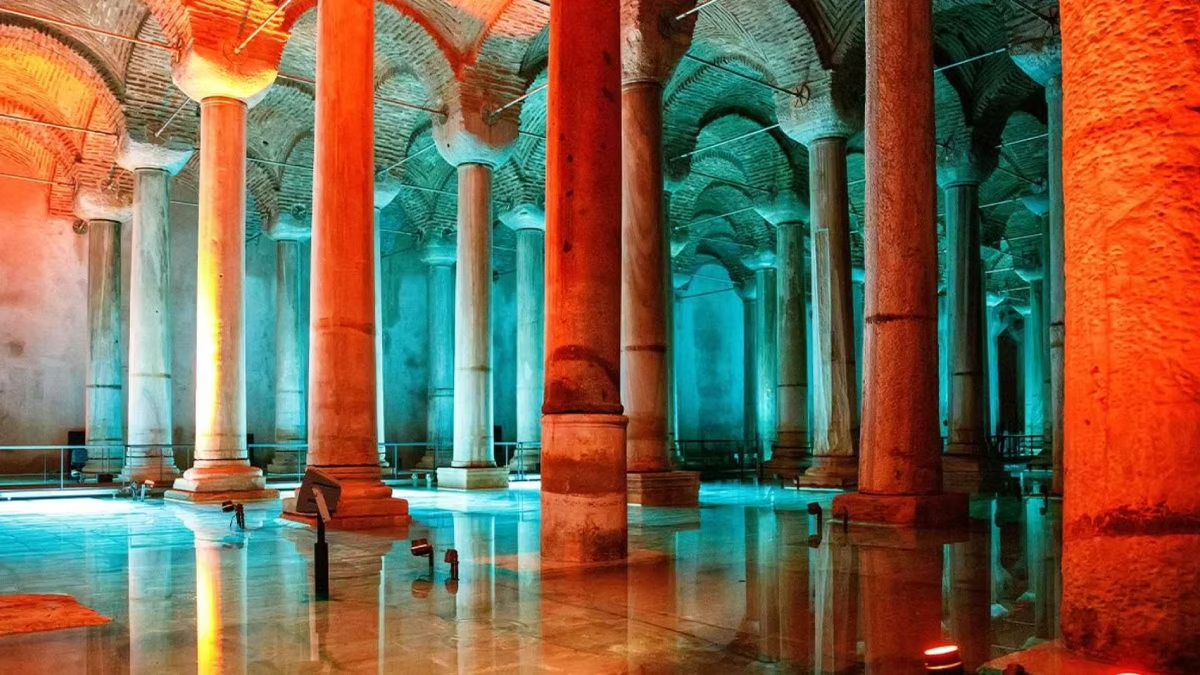
The Basilica Cistern has appeared in some of the most culturally influential films, novels, and video games of the past 60 years. Key appearances include: James Bond’s From Russia With Love (1963), where Sean Connery rows a boat through the cistern during a chase sequence; Dan Brown’s novel Inferno (2013) and its 2016 film adaptation starring Tom Hanks, where the cistern forms the climax; Jean-Baptiste Andrea’s thriller Brotherhood of Tears (2013); Christopher Reeve’s The International (2009); the video game Assassin’s Creed: Revelations (2011) with a dedicated “Yerebatan Cistern” memory sequence; and Age of Empires IV, where the cistern appears as a Byzantine Castle Age Landmark. Literary appearances include Dorothy Dunnett’s novel Pawn in Frankincense (1969). The cistern’s recurring use in thrillers reflects its uniquely atmospheric combination of underground setting, columns, and water that filmmakers and writers find irresistible.
Few ancient buildings have had a more varied second life in popular culture than the Basilica Cistern. Across six decades, the 6th-century Byzantine reservoir has served as the setting for Bond-franchise espionage, Dan Brown’s religious-historical thrillers, action video games, strategy games, and literary fiction. Its atmospheric qualities — dim underground space, reflective water, 336 marble columns, and the Medusa heads — translate exceptionally well onto screen and into prose.
This article catalogues the cistern’s major cultural appearances, explains why filmmakers and writers return to it so often, and suggests how visitors can engage with the site through the lens of its cultural history. All information reflects confirmed uses; productions not verified in multiple sources aren’t included.
Why the Cistern Works on Screen
Before cataloguing specific appearances, it’s worth understanding why the Basilica Cistern has proved so attractive to filmmakers. The site combines several qualities rarely found together:
- Visually unique — a “forest” of 336 marble columns is immediately identifiable and unlike any other setting
- Built-in lighting drama — atmospheric LED lighting (and, before 2022, warm ambient light) creates natural shadow patterns that cinematographers love
- Water and reflections — the shallow water surface creates reflective visuals that double the perceived space and add cinematic quality
- Claustrophobic scale — the underground setting creates psychological compression that works well for thrillers
- Mythological associations — the Medusa heads specifically invoke Greek mythology, useful for writers exploring ancient themes
- “Hidden beneath the surface” symbolism — the literal underground quality maps onto themes of secrets, concealment, and suppressed history
- Istanbul setting — the cistern grounds stories in a real, specific city with its own strong cultural identity
These qualities explain why so many Istanbul-set thrillers funnel their action through the cistern. For writers seeking a “signature Istanbul” location that isn’t Hagia Sophia or the Blue Mosque, the cistern is the natural choice.
The Cistern in Film
From Russia With Love (1963)
The cistern’s most famous screen appearance, and the one that introduced it to international audiences.
In the second James Bond film, Sean Connery’s James Bond rows a small boat through the Basilica Cistern during a pivotal sequence. Bond is investigating the Soviet consulate, and the cistern’s underground tunnels are depicted (fictionally) as running beneath it, allowing clandestine surveillance. The film places the cistern geographically incorrectly — the actual Soviet (now Russian) consulate is in Beyoğlu, across the Golden Horn from the cistern — but cinematic license makes this a forgivable liberty.
The film also misidentifies the cistern’s builder, attributing it to Constantine rather than Justinian. Again, cinematic license prevails.
What matters is the visual introduction: for most Western viewers in 1963, this was the first glimpse of the Basilica Cistern. The shot of Bond rowing through dark water between columns, lit by lantern, became an iconic image of mysterious Istanbul. Director Terence Young and cinematographer Ted Moore helped establish the cistern’s cinematic reputation that subsequent films would build on.
At the time of filming, the cistern was still filled to significant depth — boats were the only way to explore it. The 1987 reopening installed walkways that changed how visitors experience the space, but From Russia With Love preserves the earlier boat-based era.
The International (2009)
The climactic sequence of Tom Tykwer’s banking thriller (starring Clive Owen and Naomi Watts) takes place in “a fantasy amalgam of the Old City” that includes the Basilica Cistern. The film takes cinematic liberties — depicting the cistern as lying beneath the Sultan Ahmed Mosque (it doesn’t) and placing the Sultanahmet complex adjacent to the Süleymaniye Mosque (which is 2km away).
The visual sequence captures the cistern’s atmospheric qualities effectively, even if the geography is mangled. For viewers unfamiliar with Istanbul, the fictional layout is seamless; for locals, it’s amusingly inaccurate.
Brotherhood of Tears / La Confrerie des larmes (2013)
Jean-Baptiste Andrea’s French thriller, starring Jérémie Renier and Turkish actor Ali Pinar, uses the cistern for a pivotal delivery sequence. Renier’s character, working as a mysterious transporter, delivers a suitcase to a client who receives the handoff in the cistern’s atmospheric interior.
The film’s use of the cistern is more restrained than many other appearances — the sequence treats the space as a character in its own right, letting the columns and water do the atmospheric work without heavy action.
Inferno (2016)
The most commercially significant cistern film of the past decade. Ron Howard’s adaptation of Dan Brown’s 2013 novel, starring Tom Hanks as Harvard symbologist Robert Langdon, reaches its climax at the Basilica Cistern — specifically at the Medusa-head columns.
In the plot, a bioengineer has hidden a genetically-modified plague virus at the cistern, inside a soluble bag submerged in the water. Langdon races to prevent the virus’s release by solving puzzles that lead him through European and Asian cultural landmarks, climaxing at the cistern.
The film uses the Medusa heads visually and symbolically — their mythological associations with petrification and destruction align with the plague threat at the cistern’s centre. The cinematography captures the cistern’s atmospheric qualities with high production value, and for many mid-2010s viewers, Inferno was their introduction to the site.
The novel preceded the film by three years and established the cistern as a plot-critical location; the film adaptation made the image global.
Other film appearances
The cistern has made minor appearances in numerous other films, including travel documentaries, Turkish domestic cinema, and various international co-productions. The major international appearances listed above are the most culturally visible.
The Cistern in Television
The cistern appears less frequently in television than in film, but notable appearances include:
- Travel documentaries — BBC, CNN, Netflix, and various European broadcasters have profiled the cistern in Istanbul-focused programmes
- Turkish television productions — Several Turkish historical dramas and thrillers have used the cistern as a setting, though these typically circulate domestically rather than internationally
- History Channel and similar documentary networks — The cistern features in programmes about Byzantine engineering, ancient water systems, and archaeological mysteries
Television use generally emphasises the cistern’s documentary and archaeological qualities rather than narrative-fiction potential. Film is where the cistern has most memorably appeared as a story location.
The Cistern in Video Games
Video games have embraced the cistern particularly enthusiastically:
Assassin’s Creed: Revelations (2011)
Ubisoft’s open-world action game, set in 16th-century Constantinople (Istanbul), features the cistern prominently. The player character Ezio Auditore da Firenze explores the cistern in a dedicated memory sequence titled “The Yerebatan Cistern.”
The game’s rendering of the cistern is impressively detailed — columns, vaulted ceilings, Medusa heads, and the atmospheric underground space are all reproduced with high fidelity. For many gamers in the 2010s, Revelations was their first virtual visit to the cistern.
The sequence is integrated into the game’s broader Istanbul narrative, depicting the cistern as a functional Byzantine/Ottoman water storage space rather than a tourist attraction, closer to its historical reality than modern visitors experience.
Age of Empires IV (2021)
Relic Entertainment’s real-time strategy game features the cistern as one of the Byzantine civilization’s two Castle Age Landmarks, named “Cistern of the First Hill.” Players who choose the Byzantines can construct the cistern as a major civilization-specific building, with game benefits reflecting its historical water-management function.
The game’s representation isn’t photorealistic but is clearly recognisable — a rendered version of the actual cistern with its characteristic column rows. Its inclusion in Age of Empires IV reflects the cistern’s iconic status as a defining Byzantine monument.
Dracula 5: The Blood Legacy (2013)
Microïds’ adventure game features the Basilica Cistern as a key location in the player’s hunt for Dracula across European cities. The cistern serves as an atmospheric puzzle environment, leveraging its existing mystery for the game’s Gothic tone.
Other video game appearances
The cistern has made cameo appearances in various other games, typically Istanbul-set adventures or strategy games seeking historical authenticity. The three above are the most substantial appearances.
The Cistern in Literature
Pawn in Frankincense by Dorothy Dunnett (1969)
The cistern plays a key role in the fourth volume of Dunnett’s Lymond Chronicles, a celebrated six-volume historical fiction series set in 16th-century Europe and the Mediterranean.
Pawn in Frankincense follows the protagonist Francis Crawford of Lymond through the Ottoman Empire, and the cistern features in a critical sequence set in the book’s Constantinople chapters. Dunnett, known for meticulous historical research, renders the cistern with period-appropriate detail — an underground space still partially unknown to 16th-century residents, consistent with the historical moment just after Petrus Gyllius’s 1545 rediscovery.
For literary fiction readers, Dunnett’s treatment remains among the most atmospherically successful uses of the cistern in prose.
Inferno by Dan Brown (2013)
Dan Brown’s novel, preceding the 2016 film, established the cistern as the climactic setting for Robert Langdon’s pursuit of a bioterrorism threat. Brown’s typical formula — symbology, historical puzzle-solving, race against time — fits the cistern’s existing mythology particularly well, and his detailed (if sometimes romanticised) descriptions of the Medusa heads and the Byzantine architecture gave millions of readers a literary introduction to the site.
The novel is commercially the most impactful literary appearance of the cistern, though serious literary critics generally regard Dunnett’s treatment as more substantive.
The Old Kingdom by Garth Nix
In Nix’s fantasy series (beginning with Sabriel in 1995), the reservoir beneath the palace in the city of Belisaere was reportedly inspired by the Basilica Cistern. The connection isn’t explicit in the text but has been confirmed by Nix in interviews. Readers familiar with both will recognise architectural and atmospheric similarities.
Other literary appearances
The cistern has featured in travel writing, journalism, and various novels set in Istanbul. Key travel writers who’ve documented the cistern include Jan Morris (whose Istanbul is among the most celebrated city portraits ever written), Orhan Pamuk (whose Istanbul: Memories and the City touches on the cistern), and Eric Lawlor. In fiction, appearances in contemporary thrillers set in Istanbul are too numerous to catalogue individually.
Why These Appearances Matter
They’ve shaped how international visitors understand the site
For many first-time cistern visitors, their expectations come from From Russia With Love, Inferno, or Assassin’s Creed rather than from guidebooks or archaeological publications. The site’s cultural presence influences how visitors perceive it — atmospheric, mysterious, thriller-adjacent, rather than purely archaeological.
This isn’t necessarily bad. Cultural representation increases visitor numbers, supports conservation funding, and gives non-specialists an entry point into Byzantine history. But it does mean the “Basilica Cistern” in most visitors’ minds is partly a cinematic construct.
They document different eras of the cistern
From Russia With Love preserves the pre-1985 boat-era cistern; Inferno captures the pre-restoration 2016 state; more recent appearances (Age of Empires IV, ongoing Assassin’s Creed updates) reflect the post-2022 space. Together, these cultural documents provide a visual history of how the cistern has physically evolved over six decades.
They’ve made the cistern genuinely famous
Without these cultural appearances, the Basilica Cistern would likely be visited by roughly the same audience as the less-famous Şerefiye (Theodosius) Cistern — tens of thousands of tourists annually rather than ~2 million. The cistern’s cultural fame is directly responsible for the visitor economics that fund its restoration and conservation. Bond, Brown, and Ubisoft have arguably done more to preserve the cistern than any single archaeologist or preservation official.
How to Engage with the Cistern’s Cultural History on Your Visit
The cistern lives in two places at once — a real heritage site and a recurring cinematic backdrop. A few small habits before, during, and after your visit help you read both layers at the same time.
Watch From Russia With Love before or after visiting: The 1963 film is widely available on streaming. The cistern sequence runs about 15 minutes and gives useful pre-visit context — particularly because it shows the cistern in its pre-restoration state, which is easy to compare against what you see today.
Read Inferno or watch the film: Dan Brown’s novel reads quickly; the Ron Howard adaptation is a standard 2-hour feature. Either layers the fictional plague-threat narrative onto the real Medusa-head columns and meaningfully sharpens that part of the visit.
Play Assassin’s Creed: Revelations if you’re a gamer: The cistern sequence sits early in the game, so you don’t need to commit to the full title to experience it. For gamers, it’s an unusually rich virtual walk-through.
Look for continuity and discontinuity: Inside the cistern, notice what the cultural appearances got right (atmosphere, column arrangement, Medusa heads) and what they got wrong (geographic placement, scale, specific details). The gap between cultural representation and physical reality is part of what makes the site interesting.
Respect the space despite the cultural fame: The cistern is a heritage site first and a cultural icon second. Don’t treat it as a film set — conservation rules (no flash, no touching, no climbing) apply regardless of which movie or game brought you there.
Frequently Asked Questions
Which films feature the Basilica Cistern?
Major films include From Russia With Love (1963), The International (2009), Brotherhood of Tears (2013), and Inferno (2016). The cistern has also appeared in numerous documentaries and smaller productions.
Is the Basilica Cistern the one from James Bond?
Yes. The 1963 film From Russia With Love features Sean Connery’s Bond rowing a boat through the Basilica Cistern. The film places the cistern beneath the Soviet consulate (fictionally) and attributes it to Constantine (incorrectly — it’s Justinian), but it’s the real Basilica Cistern.
Is the cistern the one from Dan Brown’s Inferno?
Yes. Both the 2013 novel and the 2016 film starring Tom Hanks use the Basilica Cistern — specifically the Medusa-head columns — as the climactic setting where a bioterrorism threat must be stopped.
What video games feature the Basilica Cistern?
Assassin’s Creed: Revelations (2011) features a dedicated memory sequence called “The Yerebatan Cistern” with the player exploring the cistern in detail. Age of Empires IV (2021) includes the cistern as one of two Byzantine Castle Age Landmarks. Dracula 5: The Blood Legacy (2013) uses it as a level environment.
Has the cistern appeared in novels?
Yes. Notable literary appearances include Dorothy Dunnett’s Pawn in Frankincense (1969), Dan Brown’s Inferno (2013), and (by Garth Nix’s own account) the cistern served as partial inspiration for fictional underground spaces in his Old Kingdom fantasy series.
Can I visit the specific spot where James Bond rowed?
The boat-era cistern was decommissioned in the mid-1980s when walkways replaced boats. You can’t recreate the boat experience, but the water surface between columns is essentially the same surface Bond rowed across in 1963.
Where are the Medusa heads from Inferno located?
In the northwest corner of the cistern — the same location used in both the novel and the film. Follow the visitor walkway to the end; the heads are clearly marked with signage.
Does the cistern still look like it does in the movies?
Mostly yes, with changes. The post-2022 restoration installed new modular steel walkways (replacing the earlier concrete ones), upgraded LED lighting, and added contemporary art installations. Core elements — the columns, Medusa heads, Crying Column, and vaulted ceiling — remain unchanged from their cinematic representations.
Why do so many thrillers set scenes in the cistern?
The combination of underground setting, atmospheric lighting, columns, water, and mythological associations (Medusa) makes it an ideal thriller location. Few other real spaces offer this combination.
Are any behind-the-scenes tours available about filming in the cistern?
Not formal tours, but audio guides sometimes mention cinematic uses. Guided tours with enthusiasts or specialist guides can cover film history if requested.
Does the cistern have its own film archive or exhibition?
Not currently. The İBB Miras team curates contemporary art exhibitions (see our art installations article) but doesn’t maintain a film-history exhibition at the site.
Is the cistern’s cultural fame hurting conservation?
Visitor numbers driven by cultural fame have increased wear and foot traffic, but have also funded the 2022 restoration. The net effect is generally considered positive for conservation, though debatable at the margins.
