
The Crying Column of the Basilica Cistern: Tears, Peacock Eyes & Theodosius
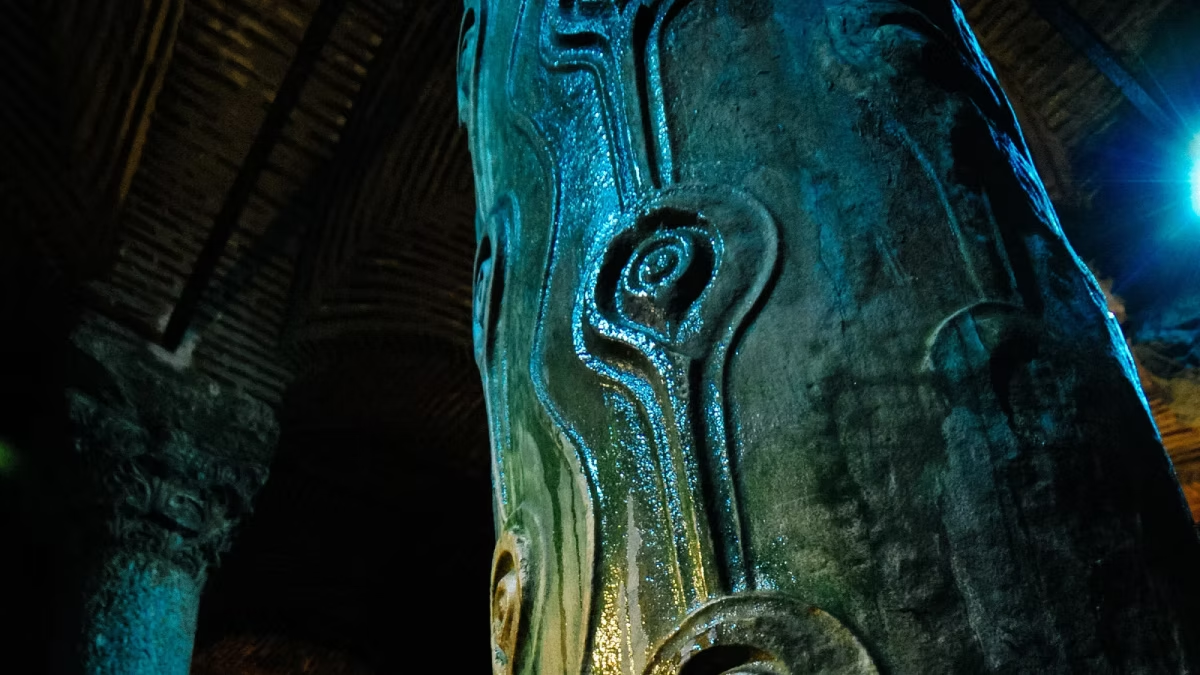
The Crying Column (also called the Hen’s Eye Column, Peacock Eye Column, or Weeping Column) is a single distinctively carved column among the Basilica Cistern’s 336 columns, featuring raised carvings of teardrop shapes, slanted branches, and peacock-eye or hen’s-eye patterns. Tradition holds that the tears commemorate the roughly 7,000 slaves who died during the cistern’s 6th-century construction. Scholars identify the column stylistically with the 4th-century Triumphal Arch of Theodosius I in the former Forum Tauri (today’s Beyazıt Square), making it spolia reused when the cistern was built. The column is located separately from the Medusa heads, typically identified by a small hole in the shaft where visitors traditionally insert a finger and make a wish while rotating their hand 360°.
The Crying Column is the second-most-famous individual column in the Basilica Cistern after the two Medusa-head columns. Where the Medusa heads draw visitors for their visual drama, the Crying Column draws visitors for its emotional weight — the tradition connecting it to the labourers who died building the cistern. Whether that tradition is historically accurate or a later romantic interpretation, the column stands as one of the cistern’s most powerful objects of reflection.
This article covers what the column actually looks like, the carving patterns and their meanings, the probable Theodosius connection, the enslaved-labourers tradition, and practical tips for finding the column among the cistern’s 336 columns on a visit.
What the Crying Column Looks Like
Among the cistern’s 336 columns — most of which are relatively plain marble shafts with Corinthian, Ionic, or Doric capitals — the Crying Column is immediately distinctive once you know what to look for:
- Raised carvings run along the column shaft in a regular pattern
- Teardrop-shaped motifs appear in vertical alignment, as if water is running down the column
- Peacock-eye or hen’s-eye patterns sit within or alongside the tear motifs — circular designs with central dots that resemble the “eyes” on peacock tail feathers
- Slanted branches or leafy motifs appear between the other decorative elements, suggesting organic growth or natural imagery
- The overall effect resembles a weeping tree — a single marble column carved as if crying
The carving is in raised relief rather than incised, meaning the patterns stand proud from the column surface. Under the cistern’s atmospheric lighting, the shadows cast by the raised carvings create a particularly striking visual effect — one reason the column is such a popular photo subject.
The column as a whole
Like the other columns in the cistern, the Crying Column:
- Stands approximately 9 metres tall
- Is made of marble, consistent with the cistern’s spolia origin pattern
- Supports the brick vaulted ceiling through a plain impost block at its capital
- Is physically indistinguishable from the other columns from a distance — you need to be within a few metres to see the distinctive carving
The wishing hole
A notable practical feature: a small round hole in the column shaft at roughly hip height, associated with a popular wishing tradition (covered below). The hole is genuine — not added by the Byzantine builders but likely created by sediment damage or later restoration work.
The Names: Crying, Hen’s Eye, Peacock Eye, Weeping
The column is known by several names, each referring to a different feature of its carving:
- Crying Column / Weeping Column — refers to the teardrop motifs running down the shaft
- Hen’s Eye Column (Tavuk Gözü Sütunu in Turkish) — refers to the circular patterns that resemble chicken eyes
- Peacock Eye Column — refers to the same circular patterns, interpreted instead as peacock-tail eyes
- Column of Tears — emphasises the commemorative interpretation
All four names describe the same column; different sources prefer different labels. In Turkish tourism literature, “Hen’s Eye Column” is most common; in English-language tourism writing, “Crying Column” or “Weeping Column” tends to dominate.
The 7,000 Slaves Tradition
The most emotionally compelling interpretation connects the column’s tears to the labourers who built the cistern.
What the tradition says
According to oral tradition, the Basilica Cistern was constructed by approximately 7,000 slaves over the course of its building programme between 527 and 542 AD. Many of these labourers died during construction due to:
- Harsh underground working conditions — damp, poorly ventilated, with primitive lighting
- Dangerous excavation — removing enormous quantities of earth and rock for the 9,800-square-metre chamber
- Physical demands — transporting and erecting 336 marble columns, each weighing several tons
- Disease — close quarters, poor sanitation, and long construction periods allowed disease to spread
- Accidents — falling stones, collapsing supports, and general construction hazards
The Crying Column, under this tradition, stands as a silent memorial to these dead — a deliberate tribute carved into a structural element of the cistern itself, allowing the labourers’ sacrifice to be remembered as long as the building stood.
What historians actually know
The 7,000-slaves figure appears in multiple Byzantine-era sources and in Ottoman accounts of the cistern’s construction, but the specific number should be treated with appropriate scepticism:
- The figure is approximately consistent with what a project of the cistern’s scale would have required (comparable projects in the Roman and Byzantine worlds used workforces in the thousands)
- Contemporary accounts don’t always distinguish between enslaved labourers, free wage labourers, and military labour. “Slaves” in Byzantine usage could mean multiple categories
- Death rates on such projects are genuinely hard to reconstruct from surviving records, but deaths during construction were common in the ancient and medieval worlds
- No specific death count for the cistern’s construction survives in any documentary source
So: the general tradition is plausible, the specific 7,000 figure is conventional rather than documented, and the connection to the Crying Column specifically is a later interpretation rather than a contemporary Byzantine statement.
The column wasn’t carved for this purpose
This is the crucial caveat. Whatever emotional meaning the Crying Column carries today, it was not originally carved as a memorial to the cistern’s labourers. The carving style predates the cistern’s construction — the column is almost certainly spolia, taken from an earlier structure.
The “tribute to dead slaves” interpretation is a post-construction tradition, possibly developed during the Byzantine era but more likely consolidated during the Ottoman period or the early-modern rediscovery of the cistern. It transforms a reused classical decorative column into a cistern-specific memorial — an interpretation that gives the building emotional resonance without necessarily reflecting the original builders’ intent.
Most modern historians accept the column’s traditional meaning as a cultural memorial rather than a literal one — something akin to a repurposed tombstone that, through continued interpretation, has become meaningful to subsequent generations even if not originally intended for its current role.
The Triumphal Arch of Theodosius Connection
Architecturally, the Crying Column has a more specific scholarly identification: it almost certainly came from the Triumphal Arch of Theodosius I, a 4th-century Roman monument in the Forum Tauri.
The Forum Tauri context
The Forum Tauri (Forum of the Bull, today’s Beyazıt Square) was one of the major public squares of late Roman and Byzantine Constantinople. Built under Emperor Theodosius I (379–395 AD), the forum included:
- A central triumphal arch commemorating Theodosius’s military victories
- Monumental statues of Theodosius and his family
- Decorative columns with elaborate carving characteristic of late-4th-century Roman imperial style
- A colonnaded perimeter with commercial and civic functions
The Triumphal Arch of Theodosius collapsed by approximately 558 AD — just as the Basilica Cistern was being completed. Materials from the arch would have been immediately available for the Byzantine reuse programme. Stylistic comparison between the cistern’s Crying Column and the surviving Forum Tauri fragments strongly suggests a common origin.
What the carving meant originally
In its original context on the Triumphal Arch of Theodosius, the column’s decoration probably had standard classical meanings:
- Peacock-eye patterns were associated with immortality and royalty in late Roman iconography — peacocks were sacred birds in some pagan cults and became Christian symbols of resurrection
- Teardrop motifs could represent water, fertility, or lamentation depending on context
- Slanted branches/leaves typically referenced natural renewal and imperial prosperity
In triumphal arch context, the combined iconography likely signalled imperial glory, dynastic continuity, and divine favour — standard late Roman imperial propaganda.
In the Basilica Cistern, detached from its original context, the same carvings read very differently. The tears become literal grief; the peacock eyes become hens’ eyes; the branches lose their imperial association. The column became a new cultural object through reinterpretation.
The Pleiades connection
A more speculative scholarly proposal connects the column’s iconography to the Pleiades — the “Seven Sisters” star cluster, known to many ancient Mediterranean cultures as “a hen with her chicks.”
The Pleiades:
- Were associated with mourning and funerals in Bronze Age European traditions
- Rose in the eastern sky during the cross-quarter festival between autumn equinox and winter solstice — traditionally a time of remembering the dead
- Became linked to tears and lamentation through this association
Under this interpretation, the “Hen’s Eye” pattern may deliberately reference the Pleiades-as-hen-and-chicks, carrying an ancient mourning symbolism that fortuitously aligns with the later Byzantine “tears for the dead” tradition. This is speculative but intriguing.
The Wishing Hole Tradition
A living folk tradition surrounds the small hole in the column’s shaft:
The practice
Visitors traditionally:
- Insert their thumb or finger into the hole
- Rotate their hand 360 degrees while the finger remains in contact with the interior of the hole
- Make a wish during the rotation
- If the finger comes out wet from moisture inside the column, the wish is supposed to come true
The column is genuinely damper than surrounding columns — the hole seems to create a small pocket where condensation collects, so thumbs often emerge with some moisture.
Origin of the tradition
The wishing-hole tradition appears to be relatively modern — most sources suggest it developed in the late 20th or early 21st century as the cistern became more touristed. It’s not documented in Byzantine or Ottoman sources.
Some accounts claim Byzantine-era emperors performed a similar ritual at the column for luck, but evidence for this is essentially absent from historical records. The tradition is probably post-1987 (i.e., developed after the cistern opened as a museum) and spread through tour guide repetition.
Whether to participate
The wishing-hole practice is a personal choice. Conservation-minded visitors sometimes note that repeated insertion of thousands of fingers annually can accelerate wear on the marble. The practice isn’t prohibited by cistern management, but it’s increasingly seen as ethically questionable among heritage-conscious travellers.
If you do participate, do so gently. If you’d rather just photograph the column and admire its carvings, that’s a perfectly respectful way to engage.
What to Look For on a Visit
Practical observations for finding and appreciating the Crying Column:
Location
The Crying Column is not in the same corner as the Medusa heads — this is a common point of confusion. The Medusa heads are in the far northwest corner; the Crying Column is elsewhere in the cistern, typically toward the east or southeast.
Look for:
- Informational signage identifying the column (most Kültür AŞ signage labels it)
- The raised carving pattern — visible from 3–5 metres away once you know what to look for
- Other visitors — the column usually has a small crowd around it, which can help locate it
- The wishing-hole queue — if there’s a queue forming mid-cistern, that’s often the Crying Column
Viewing the carving
The carving is clearest under direct lighting. Modern LED lighting installed during the 2022 restoration specifically illuminates the column’s distinctive features — the teardrop and eye patterns are easier to see than during earlier periods.
For best viewing:
- Walk slowly around the column to see the carving from different angles — the pattern repeats but looks different with light from different directions
- Look at the column from low angle — photographing from below emphasises the vertical “weeping” effect of the carving
- Compare to adjacent columns — the contrast with standard plain columns makes the Crying Column’s elaborate carving more striking
Photography
The column rewards both close-up detail photography (focus on the carving patterns) and wider contextual shots (the column with surrounding water and reflections). Don’t use flash — it’s prohibited and ineffective against the atmospheric lighting anyway.
Time spent
Budget 10–15 minutes at the Crying Column if you’re a thorough visitor. Most people walk past in under 2 minutes, which misses the detail that makes the column interesting. Taking time to look at individual tear-motifs and eye patterns rewards close observation.
Audio guide content
The cistern’s standard audio guide covers the Crying Column’s history, the Theodosius connection, and the slaves tradition. If you have the audio guide, use it at this stop — the content here is among the better audio material in the cistern.
Why the Crying Column Matters
The Crying Column’s significance goes beyond its individual beauty. Three aspects make it historically important:
It represents collective memory of labour
Whether or not the original carving was intended as a memorial, the column has become one. Through centuries of oral tradition, it has collected the memory of the enslaved labourers who built the cistern — workers who left no other trace in the historical record. The column functions as a folk memorial that the official Byzantine record never created.
It bridges pagan and Christian iconography
The column’s original peacock/laurel imagery carried late-Roman imperial meaning. Its current “Crying Column” identity carries Byzantine Christian or post-Christian humanitarian meaning. In a single object, you can see the transition from one interpretive framework to another.
It demonstrates the power of reinterpretation
A column carved in the 4th century for imperial triumphal celebration, reinstalled in the 6th century as structural infrastructure, was reinterpreted over subsequent centuries into a memorial for construction dead. The same marble carries different meanings in different eras — a concrete example of how meaning is constructed rather than intrinsic.
Frequently Asked Questions
What is the Crying Column at the Basilica Cistern?
A single column among the cistern’s 336 that features distinctive raised carvings of teardrop shapes, eye patterns (hen’s eyes or peacock eyes), and slanted branches. Traditionally interpreted as a memorial to labourers who died during the cistern’s construction.
Why is it called the Crying Column?
Because of the teardrop-shaped carvings that run down the column shaft, creating the visual impression of a weeping figure or a column shedding tears.
Is it the same as the Hen’s Eye Column?
Yes. The Crying Column, Weeping Column, Hen’s Eye Column, and Peacock Eye Column are all names for the same single column. Different names emphasise different features of the carving.
Did 7,000 slaves really die building the cistern?
The 7,000-labourers figure appears in traditional accounts but isn’t precisely documented in surviving historical records. Construction deaths certainly occurred and were probably significant, but the specific number should be treated as traditional rather than historical.
Was the column really carved as a memorial?
Probably not originally. The column is spolia — likely taken from the 4th-century Triumphal Arch of Theodosius I in the Forum Tauri. Its current interpretation as a memorial to the cistern’s labourers is a post-construction tradition that developed over centuries.
Where is the Crying Column located?
Separate from the Medusa heads. Look for signage identifying it in the main cistern area. Small queues often form around it for the wishing-hole tradition.
What’s the wishing-hole tradition?
Visitors insert a finger into a small hole in the column, rotate their hand 360 degrees while making a wish, and if the finger comes out wet, the wish is supposed to come true. This tradition is modern (post-1987 mostly) rather than Byzantine.
Should I participate in the wishing-hole tradition?
It’s a personal choice. Conservation-minded visitors note that repeated contact may accelerate wear. The practice isn’t prohibited, but photographing the column is a fully respectful alternative.
How do I find the Crying Column?
Look for the informational signage, the distinctive raised carvings, and often a small group of visitors around it. It’s not in the northwest corner (where the Medusa heads are) — it’s elsewhere in the cistern.
Can I touch the carvings?
Conservation guidance discourages touching heritage surfaces. The column is behind a viewing barrier in some areas of the walkway; the wishing hole is the one accessible contact point.
What does the Peacock Eye pattern mean?
In original Roman imagery, peacock-eye patterns signalled immortality and royalty — peacocks were sacred in some pagan cults and became Christian symbols of resurrection. On the Triumphal Arch of Theodosius, they likely carried imperial glory imagery. In the cistern context, the meaning has shifted to grief and memorial.
Is there more than one Crying Column?
No — the Basilica Cistern has exactly one column with this distinctive carving. The other 335 columns have plain shafts of varying style.
