
Is the Basilica Cistern Worth Visiting?
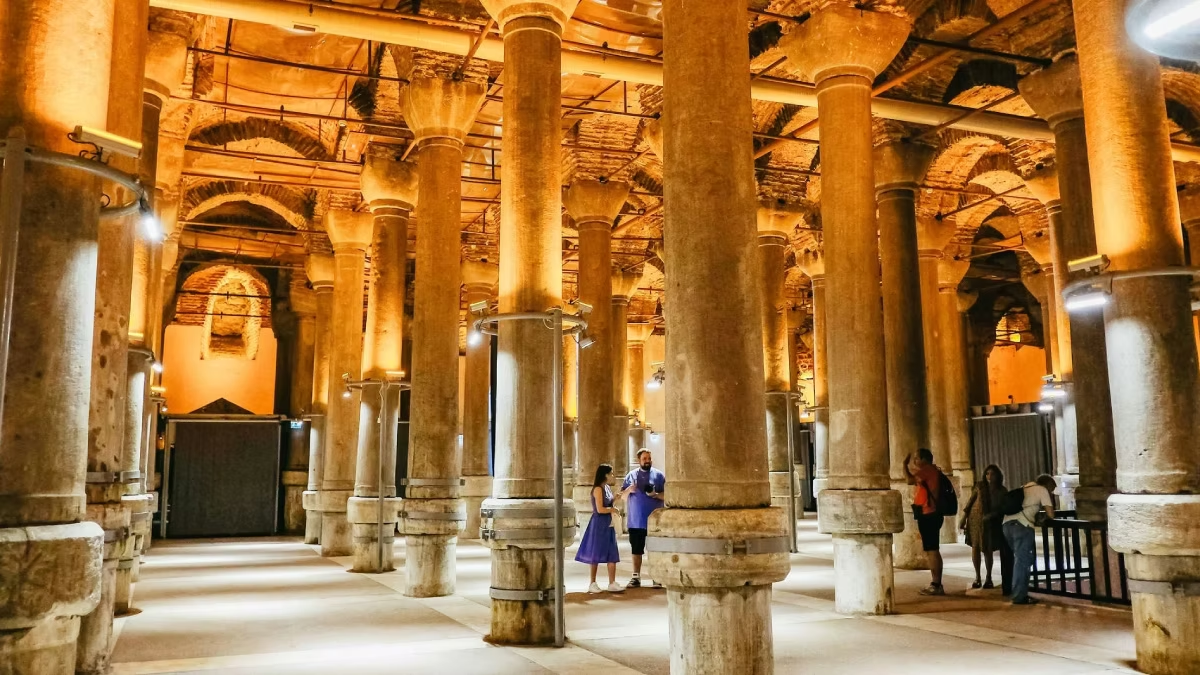
Yes, the Basilica Cistern is worth visiting for most travellers in Istanbul. It’s one of the best-preserved Byzantine buildings in the world, visually unlike anywhere else in Europe, and a short enough visit (60–90 minutes) to fit into any itinerary. The 2022 restoration added modern walkways, dramatic lighting, and contemporary art installations. It’s most worth it for history lovers, photographers, families with children aged 5+, and anyone who enjoys atmospheric underground spaces. It’s less worth it for travellers who have a tight budget and already plan to visit Hagia Sophia and Topkapı, or for those expecting a lot of interpretive content — the cistern is experiential rather than educational. At roughly €45 for a daytime ticket in 2026 (higher than many European museums), it’s not cheap, but the experience is genuinely unrepeatable elsewhere.
“Is the Basilica Cistern worth visiting?” is the single most-searched Istanbul travel question after “how to get to Hagia Sophia.” It’s a fair question. The cistern sits on the same short list as Hagia Sophia, Topkapı Palace, and the Blue Mosque — but unlike those three, it’s less universally recognised, the ticket price has climbed sharply in recent years, and the visit itself is short. Plenty of first-time Istanbul travellers end up with a schedule where something has to give, and the cistern is often the one on the fence.
This guide is an honest look at what you’re paying for, who tends to love the visit, who tends to leave underwhelmed, and how the cistern compares to its neighbours. It’s written assuming you can tell the difference between “worth it for most people” and “worth it for you specifically,” which are different questions.
The Short Answer
Yes. For the overwhelming majority of first-time visitors to Istanbul, the Basilica Cistern is worth the 60–90 minutes and the ticket price. Three reasons drive this conclusion:
- It’s genuinely unique. There’s no comparable underground Byzantine interior anywhere else that’s similarly accessible, well-lit, and restored. You cannot see this in Rome, Paris, or London.
- It’s short. The visit is 45–90 minutes, far less than Hagia Sophia or Topkapı. Even with a tight Istanbul itinerary, it fits.
- It photographs and remembers well. People forget a lot of museum visits within weeks. Nobody forgets the columns rising out of black water with an upside-down Medusa head at the far end.
That said, “worth it” depends on what you personally value. The rest of this guide breaks that down honestly.
What’s Actually There: Setting Expectations
Before you can decide if it’s worth visiting, it helps to understand what you’re actually paying to see — because first-timers sometimes arrive expecting something different.
The Basilica Cistern is a single underground chamber, about 140 metres long and 70 metres wide. Inside:
- 336 marble columns rise from a shallow pool of water. The columns are 9 metres high, arranged in 12 parallel rows of 28 each.
- Modern steel walkways loop through the space, raised above the water. You don’t walk on the original floor.
- Atmospheric lighting (post-2022 restoration) shifts between warm amber, deep red, and soft blue.
- The two Medusa Heads — carved stone bases in the far northwest corner, one on its side, one upside down.
- The Crying Column — a single column carved with teardrop patterns, in the central hall.
- Contemporary art installations — rotating sculptural pieces added after 2022, integrated into the space.
- Still water with fish — small freshwater fish still swim in the shallow water.
The whole visit is one continuous underground loop. There are no side rooms, no upper galleries, no secret chambers. If your mental image is Hagia Sophia’s layered complexity or Topkapı’s courtyards full of treasure, the cistern is a simpler experience. The power is in the atmosphere, not in the volume of content.
The Cost Reality in 2026
Let’s put the ticket price in context. The Basilica Cistern charges 1,950 TL for a daytime ticket in 2026, which is roughly €45 / US$50 depending on the exchange rate. The Night Shift is 3,000 TL (roughly €70 / US$75).
For comparison:
- Hagia Sophia upper galleries: €25
- Topkapı Palace + Harem: around €45
- Blue Mosque: free
- Colosseum in Rome: €18
- Paris Catacombs: €29
- London’s British Museum: free
The cistern is expensive by European museum standards. Istanbul’s ticket prices for foreign tourists jumped sharply after 2023 — a policy that has drawn criticism, but which appears stable for 2026. Turkish citizens pay much less; the foreign-visitor rate reflects a deliberate two-tier pricing model.
This matters because it reframes the “worth it?” question: you’re not comparing the cistern to free London museums, you’re comparing it to a specific experience at a specific price. At €45, is the cistern worth it? For most people, yes — especially because you can’t see anything remotely like it elsewhere. But it’s not a bargain in the way it was a decade ago.
Who Will Love the Basilica Cistern
Certain traveller profiles consistently rate the cistern among their favourite Istanbul experiences. If you fit one of these, you should go:
History and architecture enthusiasts
The cistern is a rare chance to see Byzantine civil engineering at a scale you can actually stand inside. It was built in AD 532 under Emperor Justinian I — the same emperor who commissioned Hagia Sophia, at the same time. The columns were salvaged from older Roman temples (the reused Medusa heads are literally spolia — construction material re-purposed from earlier structures), making the cistern a physical record of how Constantinople recycled its own past. History buffs find this fascinating in a way pure museum displays rarely achieve.
Photographers
The combination of symmetrical column rows, reflective still water, and dramatic red-amber lighting makes the cistern one of the most photogenic interiors in Europe. The 2022 lighting scheme was designed specifically with modern photography in mind. Even casual phone-shooters leave with images they’re proud of. Serious photographers will want the full camera rules and best shots guide.
Families with children aged 5–10
This is a surprisingly strong family visit. The Medusa heads tap into every kid who’s encountered Greek mythology (via school, Percy Jackson, or countless video games), the fish in the water hold toddler attention, and the visit is short enough not to exhaust small children. Free entry for under-7s helps. See our visiting with kids guide for specifics.
Fans of atmospheric, immersive spaces
If you’ve enjoyed places like the Paris Catacombs, Tokyo’s unused underground flood tunnels, or Budapest’s thermal baths, the cistern fits the same emotional register — a large, quiet, visually distinctive space that rewards lingering. The Night Shift session, in particular, is designed for people who enjoy this kind of atmospheric immersion.
Anyone who’s read Inferno by Dan Brown or watched From Russia with Love
The cistern features in the Dan Brown novel and the 1963 James Bond film, and a surprising number of visitors turn up explicitly because of one of those. If you’re one of them, yes, it delivers — it’s one of the few famous book/film locations that’s genuinely as atmospheric in person.
First-time Istanbul visitors who want variety
Most Istanbul must-sees are above ground — mosques, palaces, bazaars. The cistern provides contrast: underground, still, dim, cool, and quiet. This is valuable in an itinerary that might otherwise feel visually homogeneous after two days.
Who Might Find It Overrated
Some travellers do come away disappointed. Being honest about this helps people avoid the mistake of expecting the wrong thing.
People expecting detailed historical content
The cistern is experiential, not educational. Information panels exist but are brief, the audio guide is decent but not scholarly, and there’s no museum-grade interpretation. Visitors who love deep context (the kind they get at the British Museum or the Louvre) sometimes leave wanting more. If this is you, hire a licensed guide or book a guided tour — the content gap disappears when a human is explaining the columns.
Travellers on very tight budgets
€45 is a meaningful amount when you’ve already committed to Hagia Sophia (€25) and Topkapı (€45). For backpackers on a 5-euro-a-meal budget, the cistern’s cost can feel disproportionate to a 60-minute experience. There’s no shame in prioritising the free-to-enter Blue Mosque and saving the cistern for a future trip.
People with significant claustrophobia or mobility limits
The cistern isn’t particularly cramped — it’s a huge underground space — but it is underground, with one entrance and exit path. Anyone with significant claustrophobia or panic around enclosed spaces should consider this carefully. The site is wheelchair-accessible via the Alemdar Street lift, but the visit involves narrow walkways and ceiling drip that can add discomfort for visitors with mobility or sensory sensitivities.
Visitors expecting “ancient ruins”
The cistern is ancient — 1,500 years old — but the interior is heavily restored and the walkways are modern. Visitors hoping for a raw archaeological experience (uncovered artefacts, rough stone floors, a sense of recent discovery) will find the 2022 renovation too polished. This is a museum, not an archaeological site.
Istanbul repeat visitors who’ve done it before
On a first trip, yes. On a second trip with limited time, maybe. The cistern is a once-is-enough attraction for many people; there’s no new content on a second visit unless you’re attending a special exhibition or doing the Night Shift after seeing it in daytime.
The 2022 Restoration: What Changed
A meaningful context point: the cistern closed in 2017 for a multi-year restoration and reopened in July 2022. Anyone describing a visit from before 2017 is describing a different experience. Key changes:
- Modern steel walkways replaced the older, narrower, uneven wooden platforms
- New lighting scheme replaced older functional lighting — colours shift, installations are designed for visual drama
- Wheelchair lift added at the Alemdar Street exit
- Contemporary art installations introduced, rotating every 6–12 months
- Night Shift programme launched as a separate evening experience
- Ticket prices increased substantially for foreign visitors
The restoration was controversial in Turkish cultural circles — some critics felt it modernised the site too aggressively, replacing a raw atmospheric quality with a “Disneyfied” lighting scheme. Most visitors disagree; the new lighting is nearly universally cited as a highlight rather than a detraction. But it’s worth knowing that what you’re visiting in 2026 is a 2022-restored version, not the raw post-Byzantine ruin of older guidebooks.
How It Compares to Other Istanbul Attractions
Short honest comparisons:
Basilica Cistern vs. Hagia Sophia
Not substitutes. Hagia Sophia is a global masterpiece — the most important Byzantine building in the world, with 1,500 years of layered religious history and mosaic art. The cistern is a beautiful piece of Byzantine civil engineering. If you can only pick one, pick Hagia Sophia. If you can pick two (and you probably can), pick both. They’re across the street from each other.
Basilica Cistern vs. Topkapı Palace
Different experiences. Topkapı is a 3–4 hour walk through courtyards, treasury halls, imperial kitchens, and the Harem. It’s content-rich and layered; the cistern is atmospheric and singular. Families with young children often find the cistern easier than Topkapı, while history enthusiasts often find Topkapı more rewarding. Many itineraries include both across different days.
Basilica Cistern vs. Blue Mosque
Not really comparable. The Blue Mosque is free, takes 30 minutes, and is essentially a single stunning architectural statement. The cistern is paid, takes 60–90 minutes, and is an immersive atmospheric experience. Do both; they don’t trade off.
Basilica Cistern vs. other Istanbul cisterns
There are over 100 Byzantine cisterns under Istanbul. Most are closed to the public. Of the ones you can visit, the Basilica Cistern is the largest and most dramatic. The Şerefiye Cistern (also operated by Kültür AŞ) is a smaller, quieter alternative. Binbirdirek Cistern is a restaurant now. If you’ve visited the Basilica Cistern and liked it, the Şerefiye is worth the €12 follow-up. If you’re deciding between them for a first visit, the Basilica wins.
The Night Shift Question
Worth addressing specifically: is the Night Shift (19:30–22:00, 3,000 TL) worth the extra over the daytime ticket?
For most people, no — a single visit, done in daytime, is plenty. The daytime lighting is still dramatic, the crowds are manageable with good timing, and the content is identical.
The Night Shift is worth the upgrade if:
- You’re a photographer specifically interested in dramatic low-light conditions
- You’re visiting the cistern for a second time and want a different feel
- You’re in Istanbul specifically for atmospheric/immersive experiences
- The daytime slots are sold out or genuinely inconvenient
For everyone else, save the premium for another Istanbul meal.
The Honest Recommendation
For a first-time visitor to Istanbul on a 3-day trip:
If you value unique experiences and have the budget: Go. 90 minutes, ideally in the 09:00–10:30 morning window, combined with Hagia Sophia the same day.
If you’re on a tight budget and must choose: Prioritise Hagia Sophia (€25, irreplaceable) and the Blue Mosque (free). Skip the cistern, come back another year.
If you’re travelling with kids 5+: Go. This might be the highlight of their Istanbul experience.
If you’re a repeat Istanbul visitor who’s done it before: Consider the Night Shift if you have a photography interest, or skip entirely and visit Şerefiye Cistern instead.
If claustrophobia or tight budgets are a serious concern: Respect them. The cistern will still be here.
What People Consistently Say Afterwards
Some consistent reactions from actual visitor reviews across 2024–2026:
- “Smaller than I expected, but more beautiful.”
- “Not enough historical information inside.”
- “The Medusa heads were the highlight — totally worth it.”
- “Ticket price felt high for how short it was.”
- “The lighting transformed what I was expecting from photos.”
- “Bring a layer — I was cold and I don’t usually get cold.”
- “The crowds in July were rough; would go earlier next time.”
- “Took better photos here than at Hagia Sophia.”
These are the honest signals. The cistern exceeds expectations aesthetically and falls short on perceived value and content depth. If those trade-offs align with what you care about, go. If they don’t, that’s also fine.
Frequently Asked Questions
Is the Basilica Cistern worth the ticket price in 2026?
For most visitors, yes. At 1,950 TL (around €45), it’s expensive by European museum standards, but it’s a unique experience you can’t replicate elsewhere. For history lovers, photographers, and families with children 5+, the value is strong.
How long do most people spend at the Basilica Cistern?
45 to 90 minutes inside, depending on crowd levels and interest. Add 15–60 minutes for queueing. See our full visit duration guide.
Is the Basilica Cistern better than Hagia Sophia?
Different experiences. Hagia Sophia is more historically and architecturally significant; the cistern is more atmospheric and photogenic. Most visitors find both worthwhile — they’re across the street from each other and easily combined.
Is the Basilica Cistern worth visiting with young children?
Yes, particularly for children 5–10. The Medusa heads tap into Greek mythology kids already know, the fish in the water hold toddler attention, and the 60–90 minute visit is short enough not to exhaust them. Under-7s enter free. Full guidance in our kids article.
Does the Basilica Cistern live up to the hype?
It depends on what hype you’ve heard. The atmosphere, photography, and Medusa heads genuinely live up to it. Expectations of deep historical content or an “ancient ruin” feel are often unmet — the 2022 restoration modernised the experience significantly.
Is the Night Shift worth the extra money?
For most visitors, no. The daytime visit at off-peak hours delivers most of the experience at a lower price. The Night Shift is worth the upgrade for photographers, repeat visitors, or anyone specifically drawn to atmospheric evening experiences.
How does the Basilica Cistern compare to the Paris Catacombs?
Both are atmospheric underground attractions, but very different in feel. The Catacombs are about death and memorialisation; the cistern is about Byzantine engineering and reflection. The cistern is better lit, shorter, and more photogenic; the Catacombs are more emotionally intense. Different moods, both worth seeing on their respective trips.
Can I skip the Basilica Cistern if I’m short on time in Istanbul?
Yes. If you only have one day in Istanbul and must choose between the cistern and Hagia Sophia or Topkapı, pick the other. The cistern is a 90-minute add-on rather than a must-see for truncated itineraries.
Is it better to visit the Basilica Cistern in the morning or evening?
Morning (09:00–10:30) is the best daytime window for low crowds and clean photography. Late afternoon (16:30–18:30) is second best. The Night Shift (19:30–22:00) is a different experience entirely, with its own ticket and atmospheric lighting.
