
Guided Tours vs. Self-Guided Audio Tours
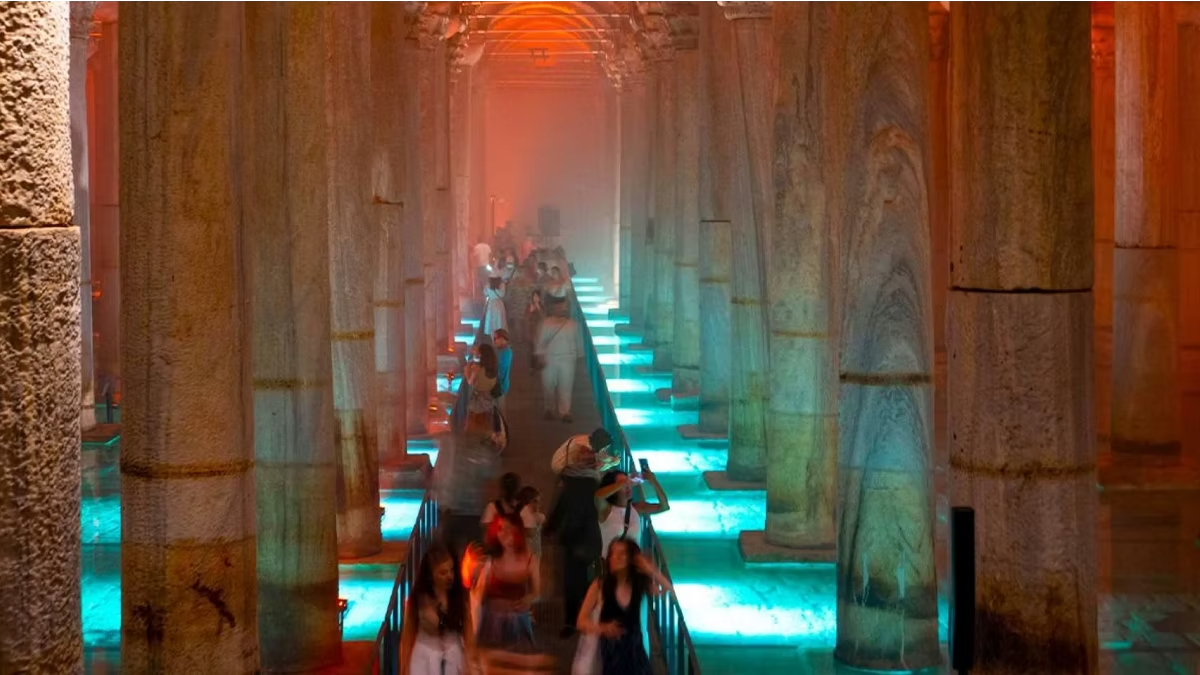
Self-guided visits with the official audio guide cost €50–55 and suit most independent travellers — the audio content covers the Byzantine history, Medusa heads, and Crying Column with reasonable depth. Live guided tours cost €45–100 depending on group size and offer meaningful advantages: the ability to ask questions, a licensed guide who often covers more cultural context, and a natural pace of 60–75 minutes. Choose a guided tour if you’re a history enthusiast, want depth beyond what panels and audio provide, are travelling as a group where shared commentary works, or are combining the cistern with other Sultanahmet sites. Choose self-guided with audio if you prefer your own pace, want photography time, are on a tight budget, or find scripted narration easier than live commentary.
The Basilica Cistern offers two meaningfully different ways to visit: self-guided with an audio app, or live-guided with a human guide. Each format has trade-offs in cost, depth, pacing, and flexibility. This guide walks through those trade-offs honestly, with specific recommendations for different visitor profiles. It’s the article to read before you book either — not after.
Neither option is objectively better; the right choice depends on your interests, your pace preferences, and whether you’re visiting the cistern as a single stop or as part of a broader Sultanahmet day.
The Two Formats: What You Actually Get
Self-guided with the audio guide
What it is: A solo visit with the official Basilica Cistern audio guide, delivered via a handheld device at the door or a dedicated app on your phone. You scan QR codes at marked stops inside the cistern and listen to pre-recorded commentary.
Typical price (2026): €50–55 for entry + audio bundled via online platforms, or 1,950 TL face-value entry + 300 TL on-site audio add-on (~€52 total).
Duration: Audio content runs approximately 45 minutes if played through every stop; total visit time is 60–90 minutes at your own pace.
Languages: Around 25 languages available, including English, German, French, Spanish, Italian, Russian, Arabic, Chinese, Japanese, and Turkish. This is one of the audio guide’s genuine strengths — live guides usually work in one language per tour.
What the content covers: Byzantine engineering background, the reign of Justinian I, the 336 columns and their Roman origins, the Medusa heads and their theories, the Crying Column legend, the Ottoman-era fate of the cistern, the 2022 restoration. Roughly the same topic list a live guide would cover.
Buy This TicketLive guided tour
What it is: A 60–90 minute walk through the cistern led by a licensed Istanbul tour guide, typically as part of a small group (8–15 people) or a private tour. The guide meets you at the entrance, handles the tickets and security coordination, and delivers live commentary throughout.
Typical price (2026): €45–65 for a small-group tour (entry included), €150–300 for a private tour.
Duration: 60–75 minutes inside the cistern, typically 90 minutes total including meet-up and brief context outside the entrance.
Languages: Usually English, sometimes Spanish, French, German, Italian, or Mandarin depending on the operator. Private tours can be arranged in less common languages.
What the content covers: Everything the audio guide covers, plus the ability to ask questions, follow-up context based on group interests, and the specific expertise of the guide — many Istanbul guides have niche specialisms (Byzantine history, Roman spolia, architectural symbolism) that surface naturally when asked.
Book This TourFor a full review of the most popular guided tour product, see our Expert Guided Tour review.
Comparing the Two: What Each Is Actually Good At
Depth of content
Guided tour: Typically slightly deeper for motivated visitors — a good guide adjusts to group interest, digs into specific questions, and can synthesise context across other Istanbul sites your group has visited. A licensed guide is expected to know material well beyond the audio guide script.
Audio guide: Consistent, rehearsed, high-quality script — but fixed. No ability to follow a tangent, drill into a specific question, or connect to your broader Istanbul experience.
Verdict: Guided tours win for depth when you have a good guide. Audio guides win for consistency — you won’t get a bad guide.
Pace and flexibility
Guided tour: The group moves together. This works for visitors who want a structured experience but constrains anyone who wants to linger at a specific column or re-photograph the Medusa heads from another angle.
Audio guide: Fully self-paced. Spend 20 minutes at the Medusa heads if you want. Skip the Crying Column audio if you’re rushed. Replay a segment.
Verdict: Audio guides win clearly for independent-minded visitors and photographers. Guided tours win for visitors who prefer structure or are travelling with children who benefit from a clear pace.
Cost
Guided tour: €45–65 for a small-group tour, €150+ private. The small-group tour is often similarly priced to a skip-the-line audio ticket, so cost isn’t a real differentiator for 2-person visits.
Audio guide: €50–55 bundled, or slightly cheaper if you buy the official website + on-site audio separately.
Verdict: For solo or 2-person visits, the cost difference is often within €10 — negligible for most budgets. For families of 4+, small-group guided tours scale better cost-wise than 4 separate audio guides, especially at family-discounted group rates.
Language fit
Guided tour: Best if you want your native tongue and a language other than English/Turkish. Private tours can be arranged in almost any language with enough lead time.
Audio guide: Wider language coverage in practice — 25 languages at standard price. The audio script is a known quality in each language.
Verdict: Audio guides win for language flexibility unless you specifically want a live guide in your language.
Interactivity and questions
Guided tour: The only option if you value asking questions. Live guides genuinely welcome engagement — it’s their job. Motivated visitors who would otherwise leave with unresolved questions benefit substantially.
Audio guide: Zero interactivity. Questions go unanswered unless you research independently afterwards.
Verdict: Guided tours win, sometimes dramatically, for engaged visitors. For casual visitors who don’t ask questions anyway, this isn’t a factor.
Ticket and logistics management
Guided tour: Guide handles entry, security coordination, group flow. Reduces your cognitive load.
Audio guide: You manage your own tickets, QR codes, security queue.
Verdict: Guided tours win for anyone who finds ticket logistics stressful — first-time Turkey visitors, non-English speakers, visitors with mobility concerns.
Fit with broader Istanbul itinerary
Guided tour: Many Basilica Cistern guided tours are actually multi-site tours that combine the cistern with Hagia Sophia, the Blue Mosque, or Topkapı. This can be highly efficient if you’re on a tight Sultanahmet day.
Audio guide: Single-site format. You self-coordinate any additional sites.
Verdict: For tight itineraries covering 3+ Sultanahmet sites in one day, multi-site guided tours win for coordination. See our nearby attractions guide for itinerary sequencing.
Who Should Choose Which
Choose self-guided with audio if you:
- Value setting your own pace and photography time
- Speak a less-common language (better audio coverage)
- Are a solo or 2-person budget traveller
- Are visiting multiple Istanbul attractions and want to self-pace throughout
- Are uncomfortable in group settings or prefer quiet
- Have already done research on the cistern and know roughly what you want to see
- Are a repeat Istanbul visitor who’s done a guided tour on a previous trip
Choose a live guided tour if you:
- Are a history enthusiast who wants depth and the ability to ask questions
- Are new to Byzantine history and want context that panels won’t provide
- Are travelling as a group of 3+ (cost scales better)
- Are on a tight Sultanahmet day and want coordination across multiple sites
- Prefer structured experiences over self-navigation
- Are not confident navigating foreign-language tickets and logistics
- Are specifically interested in the cistern’s architectural details or specific features (Medusa heads theories, Roman spolia, Ottoman-era use)
The case for doing both on separate visits
For Istanbul repeat visitors or anyone on a longer Istanbul trip: a first visit with a guided tour gives you the story and context, and a second visit — daytime or Night Shift — with self-guided audio lets you revisit at your own pace, photograph without group timing, and spend longer at features you now care about specifically. Many photographers and history enthusiasts do this.
Things Neither Format Does Well
Worth flagging honestly:
Both formats run short on deep engineering detail. The cistern is a marvel of Byzantine hydraulics — pressure management, water distribution, connections to the aqueducts — that neither the audio guide nor a typical guided tour covers in technical depth. If you’re an engineer or architect, you’ll want supplementary reading.
Neither format gives access to restricted areas. There are no “behind the ropes” tours of the Basilica Cistern, no access to the original stone floor, no crawl-through exploration of the Roman aqueduct connections. Unlike Hagia Sophia (which offers rooftop access tours) or Topkapı (which has multiple restricted zones open with permit), the cistern is a single public loop either way.
Neither format provides shop discounts or perks. There’s no gift-shop voucher, no café partnership, no “free postcard” benefit. The ticket is the experience, start to end.
Budget Comparison
A quick side-by-side for an adult visitor in 2026:
- Official website face-value + on-site audio: 1,950 TL + 300 TL = ~€52
- Online platform entry + audio: ~€52 (effectively identical)
- Small-group guided tour via an online platform: €45–65
- Private 2-hour guided tour: €150–300 total (often 1–4 people)
- Combo ticket + audio (Cistern + Hagia Sophia): ~€75
- Small-group guided tour (3 Sultanahmet sites): €80–120
For full ticket pricing context, see our Basilica Cistern tickets guide.
One Important Note on “Guided Tour” Marketing
Not every product called a “guided tour” includes a live guide inside the cistern. Some reseller products labelled as tours actually deliver:
- A brief guide introduction outside the entrance (10–15 minutes)
- Then self-guided entry with an audio guide inside
These hybrid products can be good value, but they’re not the same as a genuinely live-guided interior walk. Before booking, check the product description for phrases like “guide accompanies inside” or “live commentary throughout” — versus “guide provides introduction” or “audio guide for interior”. Our Expert Guided Tour review breaks down this distinction for the specific product.
Frequently Asked Questions
Is a guided tour of the Basilica Cistern worth it?
For history enthusiasts, groups of 3+, or anyone wanting depth beyond the audio guide, yes. For solo budget travellers or photographers who prefer self-pacing, a self-guided audio visit is usually better value. Cost-wise, the two formats are often within €10 of each other.
How much is a guided tour of the Basilica Cistern?
Small-group guided tours typically cost €45–65, including entry. Private tours run €150–300 total and usually cover 1–4 people at a flat rate. Multi-site guided tours (Cistern + Hagia Sophia + Blue Mosque) cost €80–120 and are efficient if you’re visiting multiple sites the same day.
Does the audio guide replace a live guide adequately?
For most casual visitors, yes. The audio guide covers the same key topics (Justinian I, Medusa heads, Crying Column, restoration) in comparable depth, and its 45-minute duration is similar to a guided tour’s interior time. Live guides win when you have specific questions or want contextual connections to other Istanbul sites.
In what languages is the audio guide available?
Roughly 25 languages including English, German, French, Spanish, Italian, Russian, Arabic, Chinese, Japanese, Turkish, Korean, Portuguese, Dutch, Polish, and more. The audio guide is one of the few options for a full self-guided experience in less-common languages.
Can I join a live guided tour spontaneously at the entrance?
Generally no — licensed guides running tours at the cistern have pre-booked groups. If you arrive without a booking and want a live guide, check online platforms for same-day small-group availability.
Are guided tours led by licensed guides?
Reputable tours booked via established operators use licensed Turkish tour guides. Turkish tourism licensing is fairly strict — licensed guides complete formal training and examinations. Unlicensed “guides” operating near the entrance are not allowed inside and should be avoided.
Can I use my own downloaded audio tour instead of the official one?
Yes. Many travel-content apps (Rick Steves, Rough Guides, various Istanbul-specific apps) have Basilica Cistern audio content. These are usually cheaper than the official guide but vary widely in quality and accuracy.
Do guided tours include skip-the-line access?
Most do — the guide handles the group’s entry through the online-ticket lane, bypassing the walk-up ticket queue. Verify on the specific product page; a few budget tours include entry coordination but not skip-the-line.
